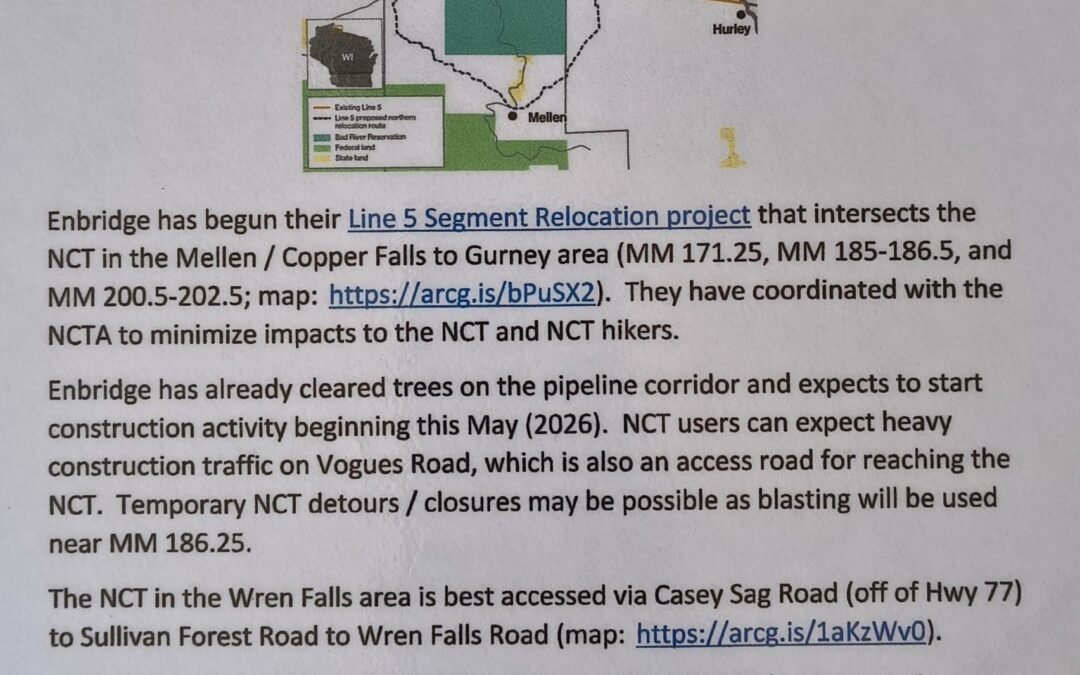
Enbridge has begun their Line 5 Segment Relocation project that intersects the NCT in the Mellen / Copper Falls to Gurney area (MM 171.25, MM 185-186.5, and MM 200.5-202.5; map: https://arcg.is/bPuSX2). They have coordinated with the NCTA to minimize impacts to the NCT and NCT hikers.
Enbridge has already cleared trees on the pipeline corridor and expects to start construction activity beginning this May (2026). NCT users can expect heavy construction traffic on Vogues Road, which is also an access road for reaching the NCT. Temporary NCT detours / closures may be possible as blasting will be used near MM 186.25.
The NCT in the Wren Falls area is best accessed via Casey Sag Road (off of Hwy 77) to Sullivan Forest Road to Wren Falls Road (map: https://arcgis.is/1aKzWv0).
On today’s show, host Esty Dinur is in conversation with four guests–Joe Bates, Matthew Borke, Rob Lee, and Gracie Waukechon–who are fighting against the reroute of the Enbridge Line 5 pipeline around the Bad River Band of Lake Superior Chippewa reservation in northern Wisconsin. Enbridge has begun construction on the reroute though the legal battle has not been fully resolved.
Joe Bates discusses how he uses his drone to observe the construction. He’s captured footage of the new easement where Enbridge plans to use horizontal directional drilling to install the new pipeline. Matthew Borke says that what we’re hearing from the Trump administration is a forked-tongue message. He encourages folks to stay informed about the legal proceedings.
Gracie Waukechon says that this issue is personal. In light of the threat that the pipeline poses to the lands and waters of the region she says, “I feel as if my future has been taken away from me.” She’s also worried about the future of resistance in light of a contract that Ashland County officials signed last month for policing protests.
Rob Lee talks about how Enbridge is starting to break ground on construction of the reroute, but it’s not a foregone conclusion that they will get final approval. He reminds listeners that the oil that passes through Line 5 passes from Canada and back to Canada, which should concern people across the political spectrum. Click here to listen to the podcast.
Canadian oil pipeline giant Enbridge has begun construction of its Line 5 crude oil pipeline Northern Wisconsin; it has secretive deals with two counties to reimburse sheriff’s departments for responding to Line 5-related protests. Anishinaabe leaders and local residents are concerned about the potential for constitutional rights violations.
Wenipashtaabe Gokee, Anishinaabe, spoke at the Feb. 24 Ashland County Board meeting, opposing the law enforcement deal: “I’ve got a duty and obligation to stand up for water. Indanishinaabekwe. I’m an Anishinaabe woman, and that’s part of my role…. I don’t like the feeling of having a target on my back.”
Enbridge had similar deals in Minnesota during the 2020-2021 construction of its Line 3 pipeline. Minnesota law enforcement agencies received $8.3 million from Enbridge through a state-run escrow account. It led to biased policing. Indigenous leaders and allies say officers committed “egregious civil and constitutional rights violations,” including surveillance, harassment, ‘pain compliance’ torture, use of rubber bullets and pepper balls, denying medical care, strip searches, and more.
Wisconsin’s deals are worse than Minnesota’s. Enbridge will pay sheriff’s departments using the Wisconsin Counties Association, a lobbying group, as the pass through. The Association is not subject to state open records laws. The public will not know how much Enbridge is paying law enforcement, names of funding sources, or how the money was spent.
Bayfield County rejected the deal on a 10-2 vote. Board Member Mary Dougherty said, “Bayfield County has a responsibility to public safety, civil liberties, and public trust—not to quietly formalize a quasi security partnership around a highly controversial pipeline project with vague funding and extremely limited transparency.”
Line 5 is a 73-year-old pipeline that carries oil from Canada, crossing the Bad River Reservation. In 2019, the Bad River Band of Lake Superior Chippewa sued Enbridge for illegal trespassing and demanded Enbridge leave their watershed. Several of Enbridge’s easements had expired in 2013, and the Bad River Band refused to renew them, citing the risk of tremendous environmental damage from any crude oil spills.
Enbridge is now working on a 41-mile pipeline reroute around the reservation. The reroute crosses hundreds of rivers, streams, and wetlands that flow into the reservation, threatening the Band’s internationally recognized wild rice beds and walleye spawning grounds. Indigenous leaders call the reroute an act of cultural genocide.
Tribes in Michigan oppose Enbridge the Line 5 oil pipeline replacement plan, arguing the environmental risks to their traditional waters far outweigh any benefits. The proposal to replace the 70-year-old pipeline that currently runs through Michigan and Wisconsin has faced many legal challenges over the years. Now, the U.S. Supreme Court will decide whether the state or federal government should have say over how the project proceeds. The decision could set a precedent on how much power tribes and states have in regulating fossil fuel development. We’ll speak with tribal leaders, Native legal scholars, and others about what’s next for the ongoing Line 5 pipeline legal battle. Listen at this link.
Guests:
Wenona Singel (Little Traverse Bay Bands of Odawa), associate professor of law at Michigan State University College of Law and associate director of the Indigenous Law and Policy Center
See the flier for more information about local government cooperation with Enbridge and Enbridge’s WDNR Permit, including public meetings to attend.
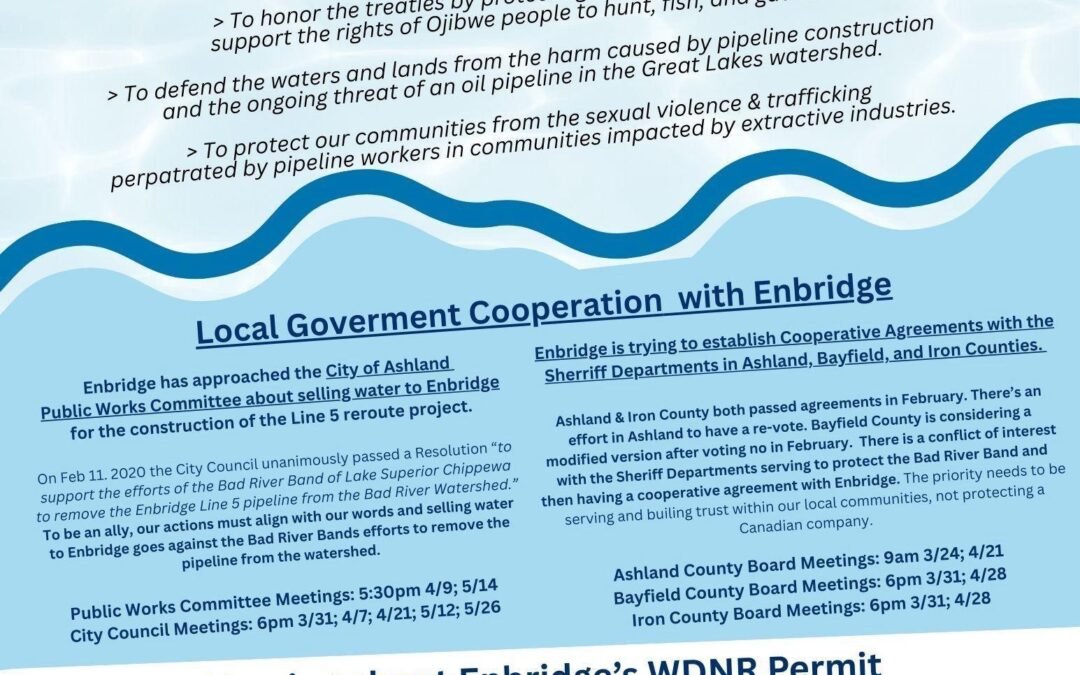
Full text of flier:
To be an ally, our actions must align with our words. We stand with Bad River!
To be in solidarity with the Bad River Band as the Band continues to assert their sovereignty as a Tribal Nation
To honor the treaties by protecting the ecosystems which support the rights of Ojibwe poeple to hunt fish, and gather.
To defend the waters and lands from the harm caused by pipeline construction and the ongoing threat of an oil pipeline in the Great Lakes watershed.
To protect our communities from the sexual violence & trafficking perpetrated by pipeline workers in communities impacted by extractive industry.
Local Government Cooperation with Enbridge
City of Ashland selling water to Enbridge Enbridge has approached the City of Ashalnd Public Works Committee about selling water to Enbridge for the construction of the Line 5 reroute project. On Feb. 11, 2020 the City Council unanimously passed a Resolution “to support the efforts of the Bad River Band of Lake Superior Chippewa to remove the Enbridge Line 5 pipeline from the Bad River Watershed.” To be an ally, our actions must align with our words and selling water to Enbridge goes against the Bad River Bands efforts to remove the pipeline from the watershed. Public Works Committee Meetings: 5:30pm on 4/9, 5/14 City Council Meetings: 6pm on 3/31, 4/7, 4/21, 5/21, 5/26
Cooperative Agreements with Sherriff Departments Enbridge is trying to establish Cooperative Agreements with the Sherriff Departments in Ashland, Bayfield, and Iron Counties. Ashland and Iron County both passed agreements in February. There’s an effort in Ashland to have a re-vote. Bayfield County is considering a modified version after voting no in February. There is a conflict of interest with teh Sheriff Departments serving to protect the Bad River Band and then having a cooperative agreement with Enbridge. The priority needs to be serving and building trust within our local communities, not protecting a Canadian company. Ashland County Board Meetings: 9am on 3/24, 4/21 Bayfield County Board Meetings 6pm on 3/31, 4/28 Iron County Board Meetings: 6pm on 3/31, 4/28
Hearing about Enbridge’s WDNR Permit
The Bad River Band is continuing to object to the WDNR permiting of the LIne 5 reroute and the case is now being heard by Bayfield County’s Judge Anderson. There is no public comment oppertunity during these proceedings. Instead lawyers representing Bad River and lawyers from the WDNR and Enbridge will be presenting their cases to the Judge Anderson for a decision. Next hearing: 1pm, Thursday April 16th Location: Bayfield County Courthouse with live streaming to the Iron County Courthouse. No virtual option