The September 15 Spawning deadline for completing water crossings has come and gone, and drilling has only just started on the white river. As stated in the Time Restrictions page, the best interpretation of the DNR’s permit decision is that “Enbridge is restricted from conducting work directly in water bodies, or in-stream work, during fish spawning seasons. HDD activities are allowed, the rationale being that they are conducted beneath the water bodies. However, temporary bridges associated with HDD sites are not allowed since they are considered to have in-stream impacts.”
Community members have called the DNR multiple times to get clarity on the exception for HDD sites, with regard to the different restrictions and interpretation of said restrictions. Unfortunately, so far no one has received a straight answer, which has been cause for concern.
Potato River: A community member reported a large spool of thick wire on the north side of Potato River HDD site next to Curry Road, and as of 9/17, Curry Road was blocked with a “road closed” sign at the intersection with Hwy 169.
Line 5 rupture near Saxon: Flow through the existing Line 5 restarted on Monday 9/14 after Enbridge completed construction on their unpermitted bypass. It was about 3 weeks after an Enbridge truck rolled into the line and broke a valve, which caused 1.3 million gallons of natural gas liquids to spill. Enbridge ignored a letter of noncompliance from the DNR to finish its construction of the bypass and restart oil transportation through their pipeline. Source Additionally, according to the National Wildlife Federation, “Enbridge is blocking state officials from the site of the spill, with federal support from the Pipeline Hazardous Materials Safety Administration (PHMSA). The Director of Climate and Energy from the NWF, Beth Wallace, said, “I have never heard of the federal agency withholding a site from state agency or local officials. There is usually a unified command that is formed that involves all levels of government officials and agencies responding, and in this case, there appears to be a level of preemption that Enbridge and the federal agency is trying to establish.”
Bad River Declares State of Emergency: Following the pipe rupture near Saxon, Leaders with the Bad River Band declared an official disaster, urging state and federal officials to step in after what they describe as weeks of silence and unanswered questions. Source.
It has been an eventful week. On August 25, a parked truck rolled over and into an active section of line 5, causing a leak of NGLs into the surround area near Saxon, WI. Households with in a half mile radius were told to evacuate, and power was cut off to the area. There are still a few families without power, and locals passing through have reported the smell of propane in the low parts of the area even now, about a week later. There was a temporary no-fly zone put in place, in the surrounding area, and CIPS trucks and employees, not sheriffs or local police, have been seen blocking public roads and directing traffic through their road block.
In response to this leak, the DNR issued a letter requesting that Enbridge stop construction on the reroute. Then a few days later, Enbridge announced that they would be pausing construction for two days while they reviewed safety standards with the roughly 700 workers they have in the area. In response to this, some groups have put out a call to ask the Governor and the DNR to revoke Enbridge’s permits entirely. See here for more updates on how Enbridge is cleaning up the leak.
The September 15 spawing deadline quickly approaches, the list of water crossings that this applies to are:
White River, Brunsweiler River, UNT of Brunsweiler River, Trout Creek, Billy Creek, Krause Creek
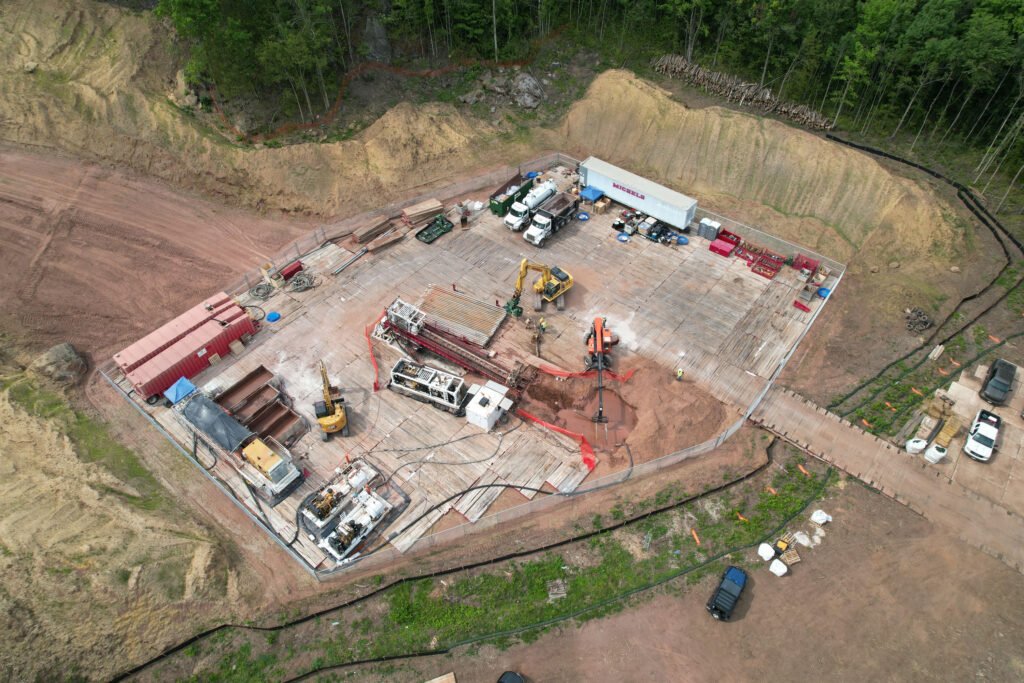
Currently there is no drill on the drillpad at the white river
September 15 is the start of spawning season, so construction effecting some water crossings is racing to finish by that date. Please make sure to be present for all current water crossing constructions, and continue monitoring crossings that have had the pipe put in already. Send any documentation of fish spawning activity to Kyle McLaughlin at the Wisconsin DNR at Kyle.McLaughlin@Wisconsin.gov
A press release from Sierra Club touched on last weeks Aug 20 hearing and shared a construction update using monitoring observations logged through watchline5.com!
Notes on observing: If oil sheen is observed on any water surface and you can get close enough to touch, please do! Natural processes of decay also produce sheens on water surface, and the quickest way to determine if what you’re seeing is a potential violation is through touch. Petroleum based slick will reform if disturbed, while the natural sheen will break apart.
If rains or winds are forecast, before and after are good times to keep an extra close eye on erosion control devices.
Work on the 4 contested waterbodies started last week after a hearing on Aug 13. The Unnamed Tributary of the Brunsweiler River [pt 36, 37] is the most sensitive of these locations, due to ongoing legal and permit issues. Judge Anderson’s reasoning for deciding not to place an emergency stay on construction at this crossing was due to not having read all the materials.
Construction ongoing at Trout Creek, points 45, 46, 47
Stay lifted at Bay City Creek [pt 3] active construction
There is a new map on the WI maps page under Construction Updates Storymap! This map serves to give a visually update on where construction is at at different points along the reroute, while also offering more context on what the pipeline is doing to the land it cuts through.
Notes on observing: If oil sheen is observed on any water surface and you can get close enough to touch, please do! Natural processes of decay also produce sheens on water surface, and the quickest way to determine if what you’re seeing is a potential violation is through touch. Petroleum based slick will reform if disturbed, while the natural sheen will break apart.
If rains or winds are forecast, before and after are good times to keep an extra close eye on erosion control devices.
Enbridge has been working as fast as they can on the reroute, despite legal setbacks in Michigan and not having the last permit needed for a water crossing. We have concerns about potentials for harm to land and water due to the pace that neighbors have observed.
Point 47– A Support Line 5 sign was placed at the end of a neighbors driveway, without the landowners knowledge or consent.
Bad River– There is active drilling at Bad river. Monitoring can be done from points 68-72
Tyler Forks River- Eyes needed on construction on Tyler Forks. Access roads can be observed from points 88 and 89.
Potato River- Work still being done on Potato River. Point 94
Silver Creek- Eyes needed here, observations can be done from points 51,52,54
Vaughn River- Work may potentially be done by now, but that does not mean monitoring should not still happen here. Enbridge workers had 3 frac- outs, and hit a spring at this HDD site alone. The damage carries on long after the drills go silent, and its important to stay by the waters side and watch for any evidence of injury over time. Observation can be done at points 97-99
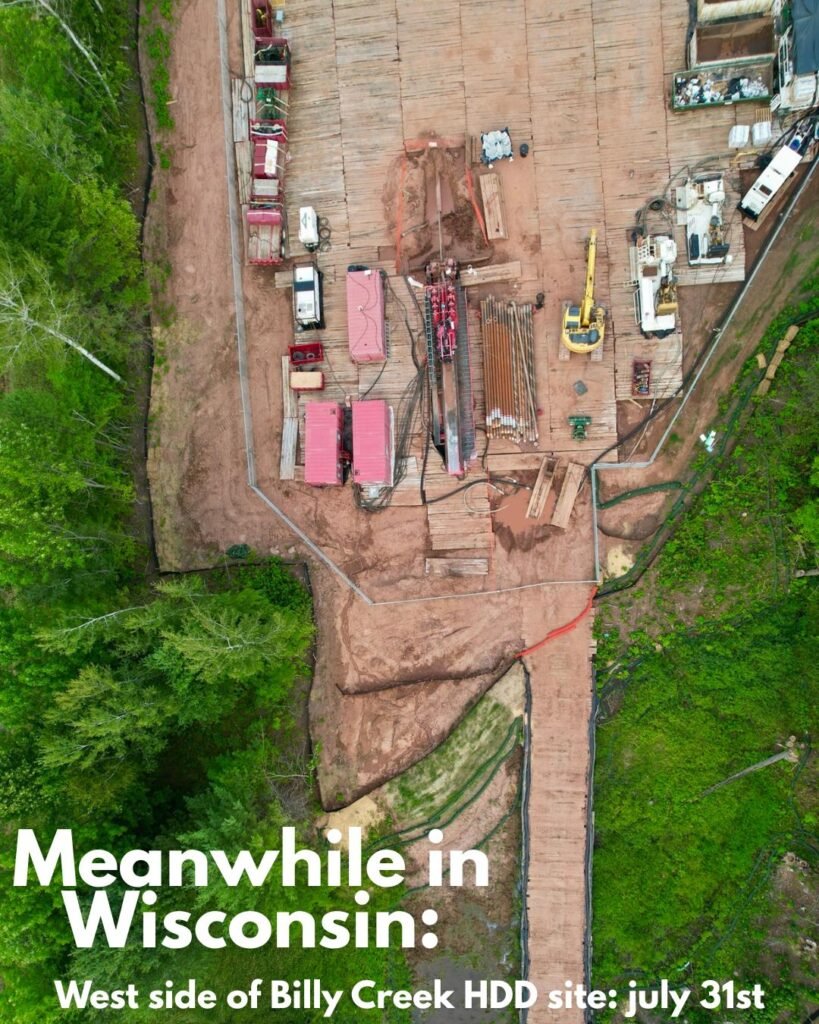
Billy Creek- As of a few days ago the construction noises died down a bit, but work can still be happening. Points 47-49
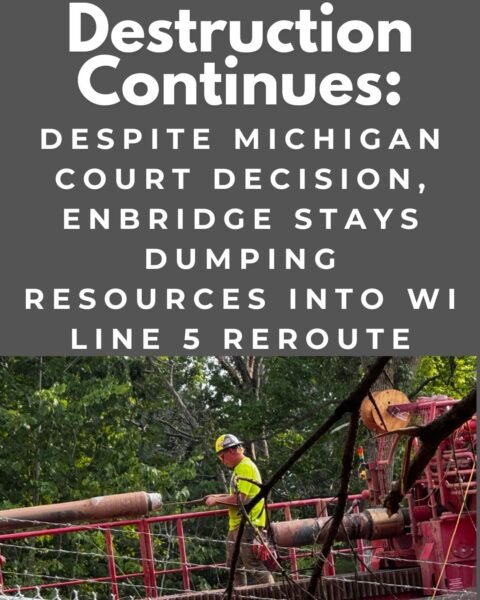
At the end of July, Michigan and federal courts delivered blows to Enbridge’s Line 5 oil pipeline. The movement to Shut Down Line 5 is now more possible than ever, due to the persistent efforts of local Tribes and allies in the Great Lakes region. Yet despite the uncertainty of the pipeline’s future, Enbridge continues to barrel forward with construction on the Bad River Reroute in Wisconsin – in large part because the courts fell short.
State and Federal Courts Rule Against Line 5, But Fail to Shut It Down
Background: The corporation has been trying to replace two sections of Line 5: the Bad River Reroute in Wisconsin, and the section beneath the Straits of Mackinac (where the company is seeking permitting to bore a new four-mile tunnel beneath the bedrock).
Bad River Reroute Update: On July 30, the federal Seventh Circuit Court of Appeals ruled that Enbridge has been trespassing on the Bad River Band of Lake Superior Chippewa’s reservation by operating a stretch of Line 5 pipeline through their land despite easements expiring in 2013. This affirmed a 2023 federal judge decision siding with the Tribe in their lawsuit against Enbridge. However, the court decision falls short in two major ways:
1) The federal court has failed to establish a timeline for Enbridge to remove the section of Line 5 through the Bad River Reservation. The court had the power to set this timeline, but instead kicked that decision to a District Court. The federal judge had ruled that Enbridge remove the section by June 16, 2026, so the company was already past the original legal deadline. Now it could take months to years for the lower court to set and uphold a new timeline. Until then, Enbridge has an ungrounded carte blanche to continue the flow of oil on Tribal lands.
2) The court ruling, same as the federal judge ruling, still allows Enbridge to build its Bad River Reroute around the reservation. The Reroute is just another direct attack on Indigenous sovereignty, threatening further harm to the Bad River Watershed, Lake Superior, and the land. The Bad River Band has demanded that Enbridge to leave their watershed, but the company refused.
Straits of Mackinac Update: On July 31, the Michigan Supreme Court overturned a key permit that Enbridge needs to bury a replacement section of Line 5 underneath the Straits of Mackinac. Next, the permit will go back to the Michigan Public Service Commission, who will have to re-analyze the projects’ environmental impacts as well as how it would affect public use rights in the Great Lakes. This is a legal victory that the Bay Mills Indian Community, other Tribal Nations and allies fought hard for.
Still, Enbridge remains allowed to operate Line 5 through Michigan. And it remains to be seen if the Michigan Public Service Commission will re-issue the permit.
Construction Continues on the Bad River Reroute
For communities affected by the Bad River Reroute, the federal court victory tastes bitter. Because of the courts’ failures, Enbridge continues rushing forward with Reroute construction.
The Bad River Tribe continues to stand up for their treaty rights and for the health of the water, the land, and future generations. On July 22, the Tribe and environmental groups filed a lawsuit challenging the legality of Enbridge building its Reroute across four waterways.
Since Reroute construction began last February, the Wisconsin DNR has issued Enbridge four notices of noncompliance. Most recently, on June 23rd, Enbridge spilled roughly 1,900 gallons of drilling fluid and bentonite clay into the wetland. The Reroute crosses nearly 200 waterbodies and impacts more than 100 acres of wetlands, impacting ecosystems and drinking water for the Bad River Tribe and other local communities.
Enbridge has a long history of releasing hazardous fluids into the watershed during its construction projects. Enbridge’s construction on Line 3 in northern Minnesota led to 28 frac-outs at 19 water crossings, which the company has yet to meaningfully remediate. With this track record, it is highly likely that Enbridge will continue to cause irreparable harm to local waterways for as long as Line 5 remains.
While the news from Michigan is thrilling, our work on the reroute side is not done yet! Here are a few hotspots based on recent observations and conversations with residents. All points in this update are HDD sites, we are focusing on them because there is concern of potential frac-outs as construction continues. Please remember to take detailed notes and describe everything you are observing with all your senses. Please note coordinates if you can, otherwise use the observation point system and leave detailed location notes. Thank you to all community monitors of the past few weeks, and all of you going out this week!
Notes on observing: If oil sheen is observed on any water surface and you can get close enough to touch, please do! Natural processes of decay also produce sheens on water surface, and the quickest way to determine if what you’re seeing is a potential violation is through touch. Petroleum based slick will reform if disturbed, while the natural sheen will break apart.
If rains or winds are forecast, before and after are good times to keep an extra close eye on erosion control devices.
Bad River- Observation from 7/25 at point 70 suggests prep for the bad river crossing.
Billy Creek- There is still active construction that can can be observed at points 47-49