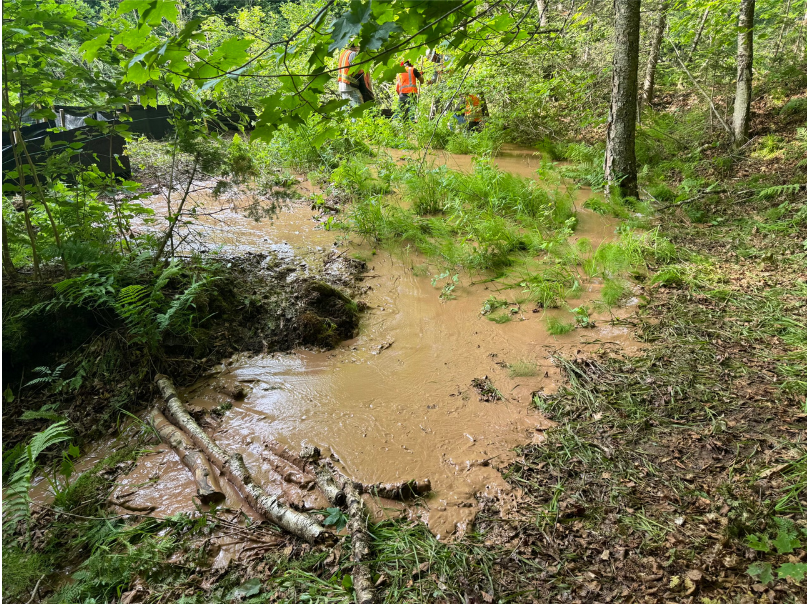
Drilling fluid spilled into a forested wetland in Iron County on Saturday, June 27, 2026. Photo courtesy of Earthjustice via the Bad River tribe (via WPR).
IRON COUNTY, WI — On June 23rd, Bad River elder Joe Bates witnessed a pool of brown slurry around one of Enbridge’s Horizontal Directional Drilling (HDD) site on the Vaughn Creek through his drone. Bates and other community members have been monitoring Enbridge’s Line 5 reroute construction for several months, as Enbridge has a history of releasing hazardous fluids into the watershed during its construction projects.
Enbridge claims that a drilling fluid spill had occurred four days later at 4:30 pm. It is estimated by the DNR that up to 1,900 gallons of drilling fluid and bentonite clay flooded the impacted wetland. Another 8 gallons of clay spilled into Vaughn Creek. Despite this direct violation of the waterway and wetland permit issued by the DNR, no stay on construction has been issued as of June 30th. This is the fourth notice of noncompliance the DNR has issued Enbridge since construction started in March.
The exact composition of the drilling fluid used by Enbridge is unknown. Although the DNR has a list of approved materials for HDD, several of these materials contain “proprietary ingredients” which are not disclosed to the public.
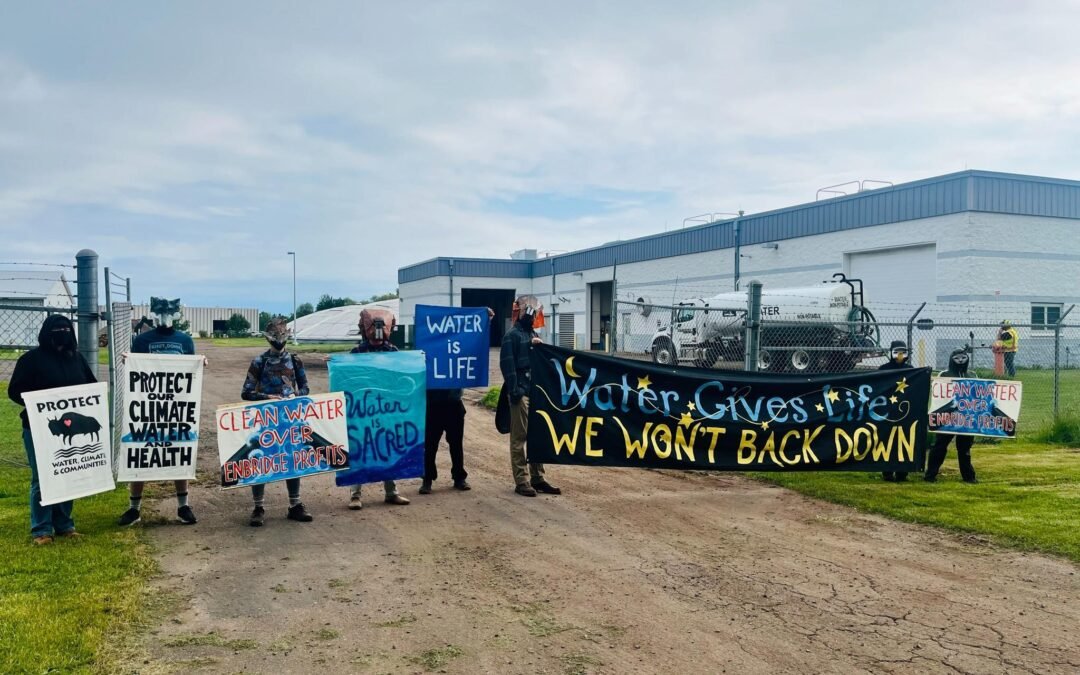
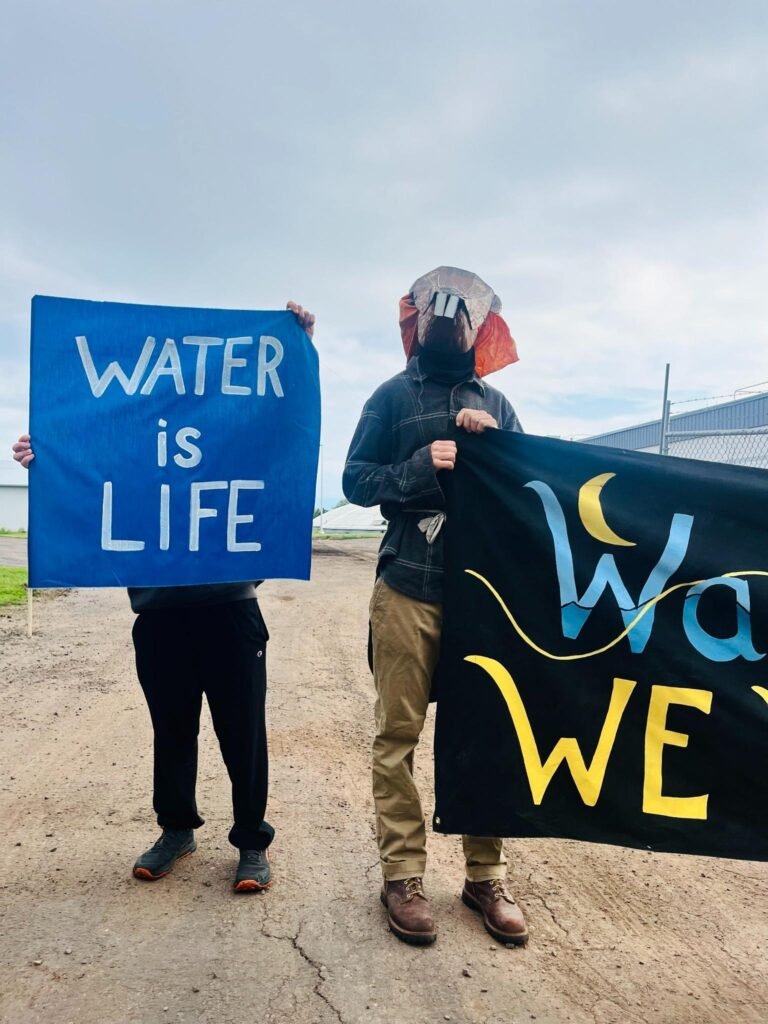
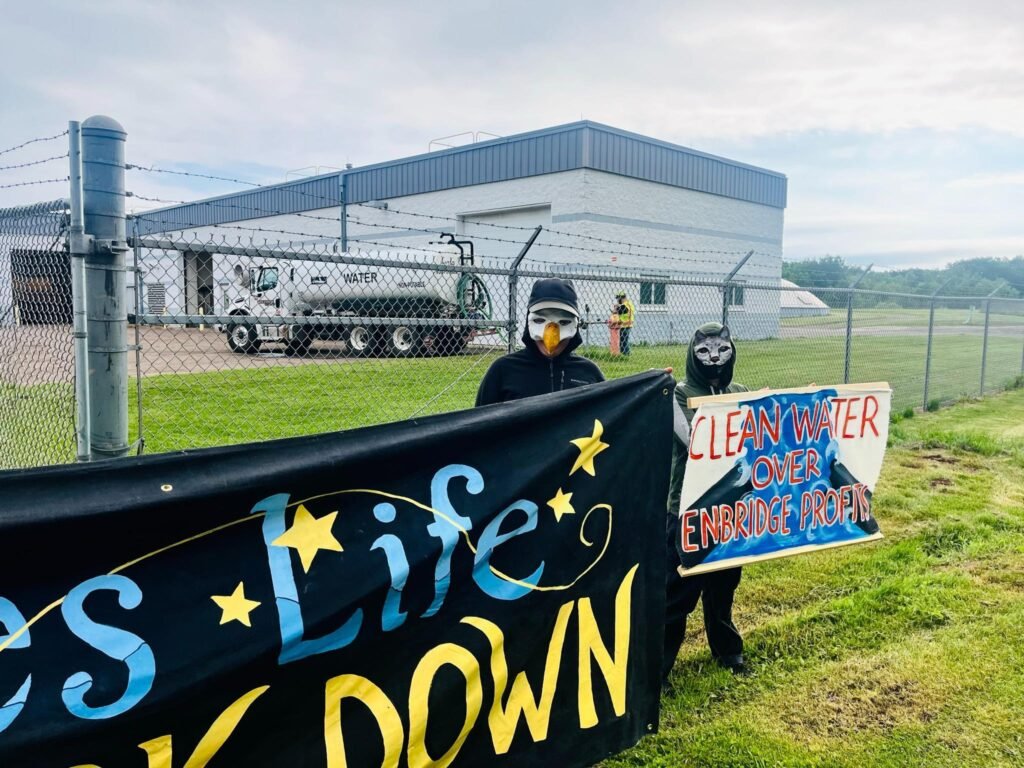
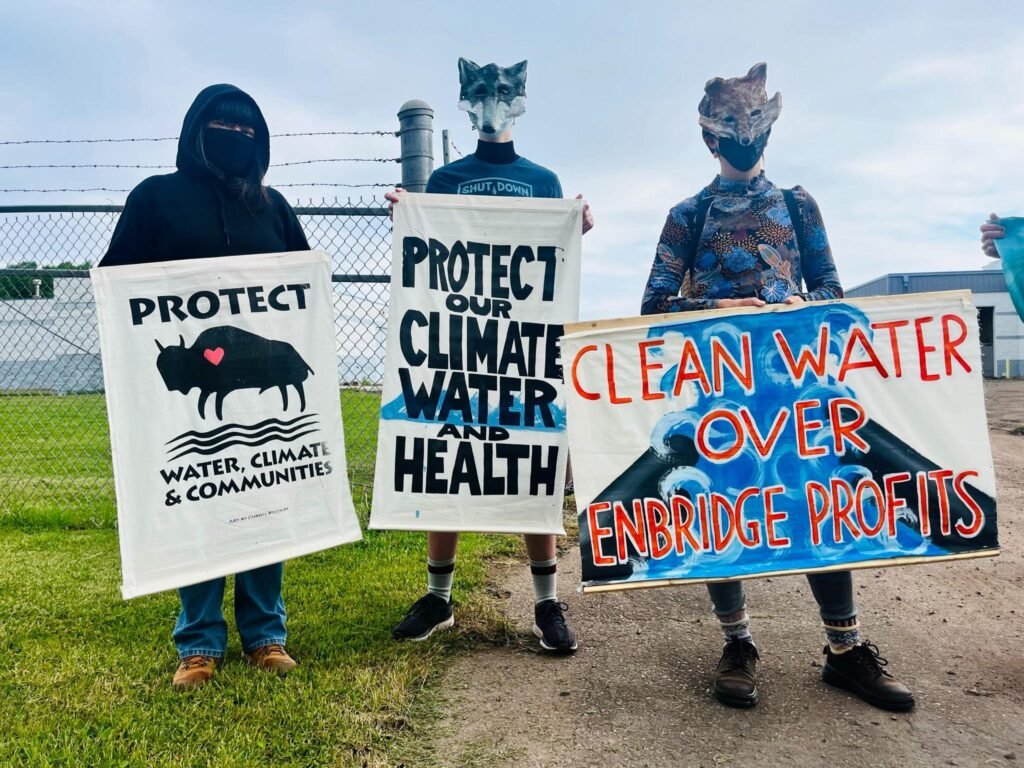
ASHLAND, WI — On Wednesday morning, June 24th, community members protested against the City of Ashland for allowing Michels’ Construction (an Enbridge subcontractor) to use municipal water in Line 5 construction. Gathered outside the municipal water station, community members wore animal puppet masks and held banners reading: “Clean Water over Enbridge Profits,” “Water is Sacred,” and “Water Gives Life, We Won’t Back Down.”
Locals have observed Michels’ water trucks filling their tanks at the municipal water station before heading to construction sites along the Line 5 route. The company is currently building a new section of Line 5 that reroutes around the Bad River Reservation, using Horizontal Directional Drilling (HDD) to bore under sensitive waterways including Silver Creek and Vaughn Creek. As part of the drilling process, Enbridge adds an undisclosed mixture of chemicals to the water they use (according to the Environmental Impact Statement), which then contaminate local waterways.
Where does the City of Ashland stand?
The Great Lakes Compact, a law that applies to the City of Ashland, states that any water taken out of a Great Lake must be returned in the same condition. The City of Ashland has not informed the public of any contract allowing Michaels to extract municipal water, so it is a mystery how much municipal water Michaels is extracting, or how the city plans to clean the water once it returns, in an unknown state, to the Ashland treatment plant and subsequently to Lake Superior.
In a statement released this morning, community members protesting shared that “Michels, a subcontractor of Enbridge, is taking precious water from Lake Superior out of the City of Ashland municipal water supply to build Line 5. This sacred water is being used to devastate our wetland and forest ecosystems and being returned with unknown contaminants for our community to deal with. This is a violation of the Great Lakes Compact and a direct threat to Anishinaabe Treaty Rights. Ashland needs to stand by their resolution of support to the Bad River Tribe and demand a halt to Michels’ water usage.”
Why does it matter that the water is used in drilling?
HDD machines use special drilling fluid in their operation called “drilling mud.” Though the exact composition of this material is unknown, Enbridge claims the fluid is comprised mostly of bentonite clay, with additives which, according to the Environmental Impact Statement, “are listed on the DNR’s Approved Horizontal Directional Drilling Products List.” This list includes four materials which contain “proprietary ingredients,” meaning the public is not privy to the ingredients of all possible additives in the fluid. Drilling fluid is known to escape the bore hole during the drilling process, in events called “frac-outs.”
Frac-outs are not simply a potential risk of HDD projects. They are a near-certain result. During the construction of Enbridge’s Line 3 in Minnesota, there were at least 28 releases of drilling fluid in or near waterways, wetlands, and other sensetive areas. It is estimated that thousands of gallons of drilling fluid were released into the surface waters along Line 3. This water usage also impacts the Treaty Rights of the Anishinaabe tribes with hunting and gathering rights protected under the1842 Treaty of La Pointe.
Full Statement from the community members:
“Boozhoo Indinawemaganodog (Hello all of my relatives)
Michels Construction, a subcontractor of Enbridge, is taking precious water from Lake Superior out of the City of Ashland municipal water supply to build Line 5. This sacred water is being used to devastate our wetland and forest ecosystems and being returned with unknown contaminants for our community to deal with. This is a violation of the Great Lakes Compact and a direct threat to Anishinaabe Treaty Rights. Ashland needs to stand by their resolution of support to the Bad River Tribe and demand a halt to Michels’ water usage.
We’re a group of local folks here today to give voice to the Indigenous wisdom we’ve heard and integrated into our hearts and visions for living a good life (Mino bimaadiziwin). We begin this message with the Anishinaabe greeting because it is an acknowledgement of all of our relatives and our interconnection. We are wolves, foxes, beavers, eagles, owls, bears, wild rice, fish and all of the waters… we acknowledge and speak for the creatures of our home and for the generations to come. They suffer from the disruption of our soils and waters, from what Enbridge is doing with our local municipal water, and from the continuation of their extractive infrastructure. It is way past time to compost these systems for healthier, more harmonious ways. We call on everybody to cultivate courage and vision, to take action for the integrity and health of our bodies, our water, and our ecosystems- simultaneously taking steps away from the temptation to go along with the industrial corporate hegemony that is connected to powerlessness, addiction and consumption. Another world is possible, let’s make it happen. Miigwech.”
A new report –prepared for the Great Lakes Business Network by the University of Michigan Law School—Environmental Law & Sustainability Clinic– about federal pipeline oversight by the Pipeline and Hazardous Materials Safety Administration is very concerning. The study analyzed all Notice of Proposed Safety Orders (NOPSO) since 2010. NOPSOs are used by the administration “to notify an operator that a particular pipeline facility has a condition or conditions that pose a pipeline integrity risk to public safety, property, or the environment.” The findings show an “alarming track record, revealing that the agency is largely reactive rather than proactive in enforcement, requiring pipeline operators to follow regulations only after ruptures, leaks, and failures have already occurred.”
Read Unicorn Riot’s coverage of the April 16th court hearing, and a deeper dive into the impacts of blasting through bedrock. Enbridge still does not know exactly where it plans to blast through bedrock.