Video – Line 5 Reroute with Joe Bates
Link: https://youtu.be/mUlR41MdqHY?is=q3ZiN2Mw1bsNusm4

Link: https://youtu.be/mUlR41MdqHY?is=q3ZiN2Mw1bsNusm4
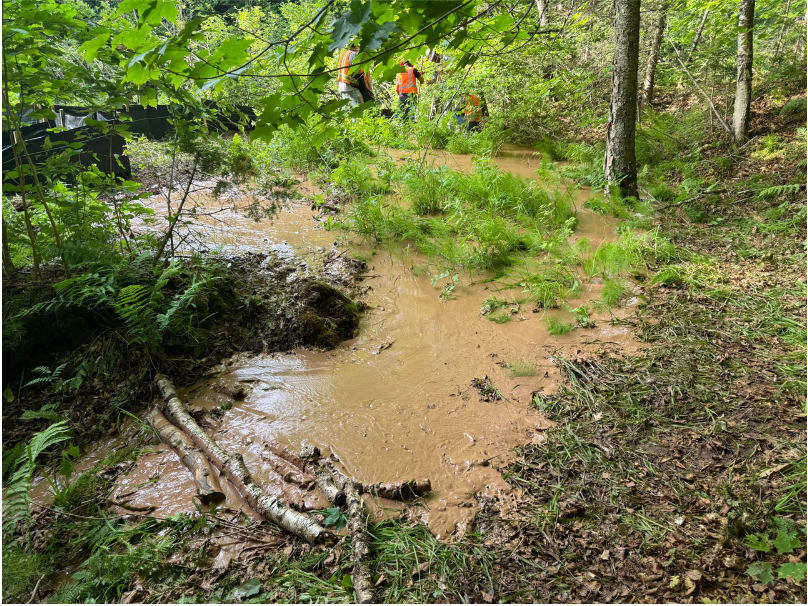
Drilling fluid spilled into a forested wetland in Iron County on Saturday, June 27, 2026. Photo courtesy of Earthjustice via the Bad River tribe (via WPR).
IRON COUNTY, WI — On June 23rd, Bad River elder Joe Bates witnessed a pool of brown slurry around one of Enbridge’s Horizontal Directional Drilling (HDD) site on the Vaughn Creek through his drone. Bates and other community members have been monitoring Enbridge’s Line 5 reroute construction for several months, as Enbridge has a history of releasing hazardous fluids into the watershed during its construction projects.
Enbridge claims that a drilling fluid spill had occurred four days later at 4:30 pm. It is estimated by the DNR that up to 1,900 gallons of drilling fluid and bentonite clay flooded the impacted wetland. Another 8 gallons of clay spilled into Vaughn Creek. Despite this direct violation of the waterway and wetland permit issued by the DNR, no stay on construction has been issued as of June 30th. This is the fourth notice of noncompliance the DNR has issued Enbridge since construction started in March.
The exact composition of the drilling fluid used by Enbridge is unknown. Although the DNR has a list of approved materials for HDD, several of these materials contain “proprietary ingredients” which are not disclosed to the public.
Full reporting from WPR can be found here
Drilling activity occurs under Silver Creek
Drone photographs taken on June 12, 2026 show the fist Horizontal Directional Drilling event of the Line 5 reroute. Contracted out to Michel’s Construction, this event is the first of 12 bores under 23 sensitive waterways flowing into the Bad River Watershed. A citizen monitor, posting to a grassroots monitoring database WatchLine5.com, shared pictures of the likely completed activity with an accompanying note:
“Completed HDD destruction. Likely started early last week and finished today (06/12/2026). Horizontal Directional Drill appears to have started on the east side of Silver Creek and fished on the west side of Highway C, where there is equipment, water trucks, and pipes being welded.”
Community monitoring images are available at https://airtable.com/appv2wvBEYWIDzDH1/shrs8E5U5bu1jVf4z/tbld7hLfYxOb0DFy8. Photos attached show evidence of Enbridge’s drilling activities underneath the Silver Creek.
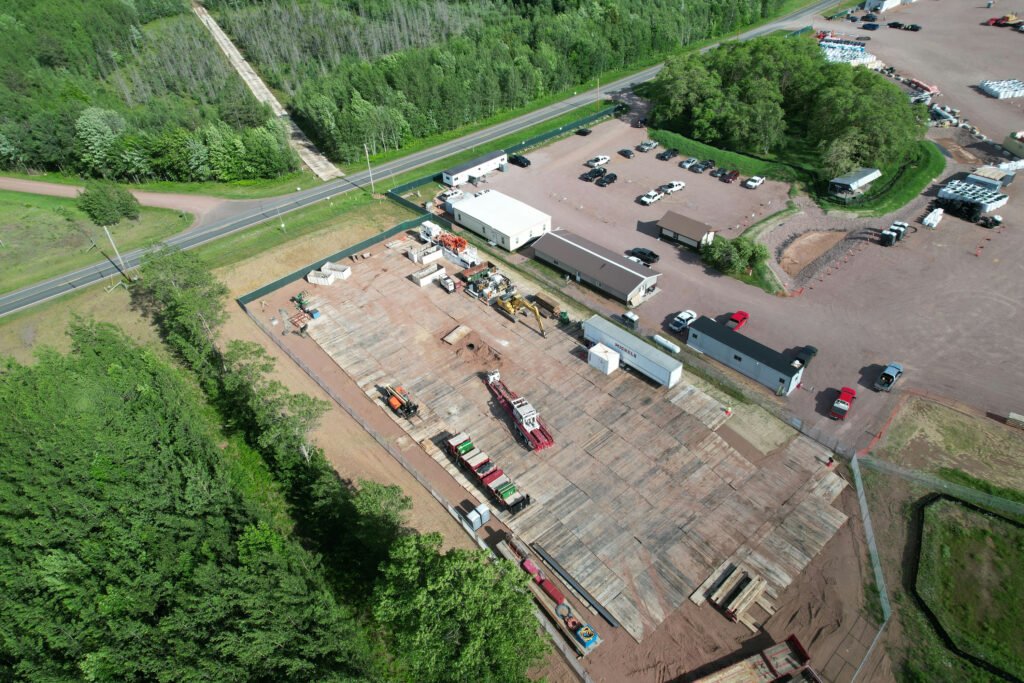
This above photo documents the Horizontal Direct Drilling machine (a white and red piece of machinery) at the center of one of the drill pads, several feet removed from one of the bore hole. At the site of the bore hole, the newly installed pipe is visible. The drilling equipment was moved shortly after these photos were taken.
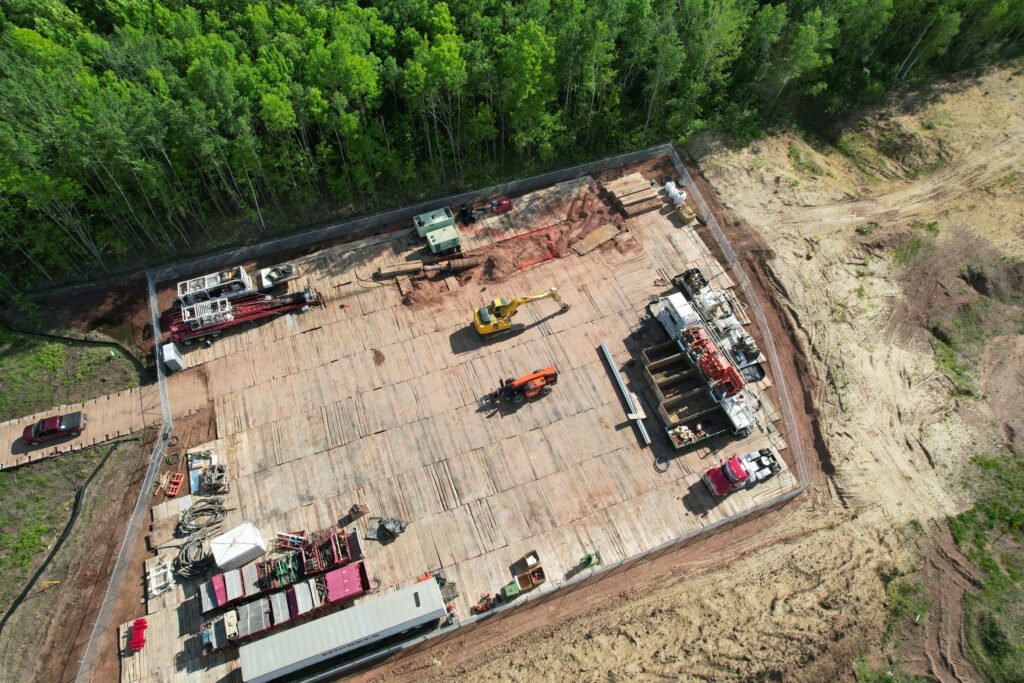
The above photo shows the opposite drill pad, covered in matting, with drilling equipment emerging from the ground. It is not publicly known if this drilling activity resulted in an ‘inadvertent release’ of toxic chemicals to Silver Creek, though monitors will continue to watch for signs of environmental damage.
These construction activities result in intense ecological harm. The installation of matting destroys habitat and remove carbon sinks. Additionally, many trees need to be cleared to perform a Horizontal Direct Drill, on the entry and exit points of the drill as well as along the access roads built to transport equipment into the drill site.
Enbridge’s recent history of Frac outs during the Line 3 project
HDD machines use special drilling fluid in their operation called “drilling mud.” Though the exact composition of this material is unknown, Enbridge claims the fluid is comprised mostly of bentonite clay, with additives which, according to the Environmental Impact Statement, “are listed on the DNR’s Approved Horizontal Directional Drilling Products List.” On this list includes four materials which contain “proprietary ingredients,” meaning even if Enbridge’s claim is true, the public is not privy to the ingredients of all possible additives in the fluid. Drilling fluid is known to escape the bore hole during the drilling process, in events called “frac outs.”
According to the Line 3 citizen monitoring group Waadookawaad Amikwag (Those Who Help Beaver, in Ojibwe), “Enbridge reported frac-outs at 67% of their HDD crossings and water protectors identified additional sites that might be un-reported frac-outs.” These frac outs documented during the construction of Line 3 resulted in the Minnesota DNR issuing Enbridge a $3.3 million fine, while drilling fluid impacts the land for generations to come.
Enbridge spilled drilling fluid 28 times at 12 river crossings in the summer of 2021 during the construction of their Line 3 pipeline expansion project, according to the Minnesota Pollution Control Agency. The largest of these officially documented spills was 6,000 – 9,000 gallons of fluid released into a sensitive Minnesota wetland ecosystem. Acknowledgement of those ‘inadvertent releases’ of toxic drilling slurry was only possible due to the work of diligent citizen scientists and community monitors who noticed the spills first.
Enbridge subcontractor Michel’s construction’s attempted to sign a contract with the city of Ashland for the sale of water for use in their drilling efforts. Substantial public opposition at city council and public works meetings led to no signing of a contract allowing such water use from the Ashland city council in February 2026, or after. Despite the lack of contract to sell water between Ashland and Michel’s construction, community monitors have witnessed water trucks filling at Ashland Water Utility facilities. The community deserves a clear answer to the question of where Enbridge is getting water to supply these drilling sites.
Ongoing Court Case
Line 5 Construction is in full swing despite a partial court-ordered stoppage, and the unresolved status of their ongoing court case. The Bad River Band and Midwest Environmental Advocates filed petitions for judicial review of the pipeline’s permits. The federal government pressured a US district Judge to stay his order of a permanent injunction on oil flowing through Bad River by June 2026 – the resolution of Bad River’s win against Enbridge trespassing on their sovereign territory. Enbridge is now legally allowed to continue to operate the existing pipeline through the reservation until the Seventh Circuit court resolves appeals on the case sometime this summer.
The Bayfield County court ruled on parts of those petitions in Mid-May. WPR summarized the decision:
“Canadian energy firm Enbridge can keep building a new stretch of its Line 5 oil and gas pipeline in northern Wisconsin except in waterways where the company needs additional permits, a Bayfield County judge ruled Friday…Under the ruling, Enbridge can’t move ahead with construction of permanent structures to stabilize banks in four creeks where erosion could threaten water quality or exposure of new pipe that would be installed.”
Enbridge, in their own promotional material, has indicated that they will continue construction of the entirety of the rest of the pipeline. The company gambles with the possibility of not receiving their permits with the tacit understanding that they will be able to successfully maneuver their case in the the legal system.
The partial stay on construction means that they can do construction as planned, all along the reroute, excepting the 4 locations where “permanent stabilization measures” are needed at water crossings. These kinds of stabilization measures require permitting since they can have dramatic impacts on waterways, which are a public good. The four streams that need individual permits are Bay City Creek, Bear Trap Creek, Little Bear Creek, and an unnamed tributary of the Brunswiller River. Up until June 15th, 92 of the navigable waterways the new pipeline route will cross will have prohibitions on work: those restrictions are to protect spawning fish.
Local communities demonstrate resilience in the face of the impending Line 5 reroute with community sugarbush. The traditional cultural event was held on the easement for Enbridge’s line 5 reroute, where the company will attempt to drill under the Bad River.
[3/29/26] Mellen, WI— Communities from the full diversity of WI – hailing from Bad River to Superior, Bayfield to Madison – gathered at the site of the Bad River Crossing, a beloved formerly public park, to demonstrate opposition to the danger posed by the multinational energy conglomerate Enbridge Energy.
“We’re resilient, but we’re not more resilient than thousands of gallons of crude oil being dumped into Lake Superior and irrevocably damaging our fisheries, wetlands, and drinking water.” says Liam Smith, resident of Bayfield, WI.
Nearly 500 acres in WI and across Lake Superior are under active threat from the rapidly advancing construction of Enbridge’s reroute of the massive Line 5 pipeline project. According to public documents, Enbridge intends to blast open stream beds, deforest fragile wetlands, and drill under rivers using toxic fracking fluids in pursuit of keeping their profits flowing.
This is not the first time Enbridge has pushed an unneeded and unsafe project on rural people in Wisconsin: Enbridge already maintains an aging and unstable Line 5 pipeline that cuts through the sovereign lands of the Bad River Band of Lake Superior Chippewa. Enbridge has a long history of oil spills: with more than 800 spills in the last 15 years. In 2022, the US District Court declared that Enbridge was trespassing on the territory of the Bad River Band, and the company was ordered to route the pipeline around the reservation border. This new pipeline segment adds threat to ongoing threat.
The gathering featured a traditional sugar bush along the Bad River: sap from maple trees throughout the region was brought in to be boiled, as the mature maples along the Bad River at the site of the sugarbush were slated to be cut in the next weeks: it is against tradition to tap trees without committing to caring for them. At the start of the day, Oneida tribal member and Elder Paul DeMain offered a welcome to those gathered, and words of support towards resistance to ongoing pipeline construction activities. DeMain said:
“…Don’t forget your responsibility for the protection of the resources, for not just us. We look at the seven generations that people contemplated when they did the treaty negotiations with the federal government- looking seven generations ahead like our elders did.”
The Many Harms of Ongoing & Completed Construction
The tribal lands of Bad River have been occupied by the Anishinaabe for hundreds of years since the migration of their people to the Great Lakes region, the place where food grows on the water. Through that time, people have continually resisted forced migration, attempted elimination, harmful assimilation, and land theft policies.
The Bad River Band of Lake Superior Chippewa has been challenging Enbridge’s Line 5 reroute project in court for more than a decade. Most recently, courts upheld DNR permits that Bad River and Midwest Environmental Advocates had challenged with lawsuits. Both the tribe and MEA have filed petitions for judicial review. The federal government pressured a US district Judge to stay his order of a permanent injunction on oil flowing through Bad River by June 2026: Enbridge is legally allowed to continue to operate the pipeline through the reservation until the Seventh Circut court resolves appeals on the case.
Trees are actively being cut along the pipeline reroute path, which travels through the Bad River’s watershed: a biodiverse and sensitive ecosystem. The DNR’s Environmental Impact Statement admits that a spill above the Brownstone Falls would send crude oil downstream into Lake Superior faster than humans could respond. Digging and blasting activities are set to begin in May.
The gathering took place at the site of the proposed drill pad: Enbridge plans on drilling under the Bad River twice on a parcel they bought from the city of Mellen that was formerly a public park.
The People of Wisconsin Deserve Better
Local communities are bracing for long term impacts of Enbridge meddling in local policing in the wake of Ashland and Iron counties accepting contracts with an intermediary to enable Enbridge to reimburse local law enforcement for pipeline related costs. Bayfield County Board is still in deliberation. Concerns around militarized equiptement and conflict of interest are forefront for communities in all three counties.
The economic and cultural significance of clean water in Northern Wisconsin cannot be understated: it underpins vital fishing, tourism, and retirement sectors. The impact of an oil spill in the Great Lakes would devastate these industries, and impact our neighbors in ports across Lake Superior. Meanwhile, the climate impacts of continued use of crude oil jeopardize the future of midwestern ecosystems, and the viability of sugarbushes into the future due to unpredictable winter weather.
For Bad River tribal members with treaty-protected hunting, fishing and gathering rights, a spill would be catastrophic. Bad River Elder Sandy Deragon:
“We can’t utilize the resources of the land when they harm the land…I brought my medicine box to the Army Corps hearing, 25 kinds of medicine I harvest, all at risk if the pipe spills.”
The following news story was posted on March 26 on Unicorn Riot:
Canadian oil pipeline giant Enbridge has begun construction of its Line 5 crude oil pipeline Northern Wisconsin; it has secretive deals with two counties to reimburse sheriff’s departments for responding to Line 5-related protests. Anishinaabe leaders and local residents are concerned about the potential for constitutional rights violations.
Wenipashtaabe Gokee, Anishinaabe, spoke at the Feb. 24 Ashland County Board meeting, opposing the law enforcement deal: “I’ve got a duty and obligation to stand up for water. Indanishinaabekwe. I’m an Anishinaabe woman, and that’s part of my role…. I don’t like the feeling of having a target on my back.”
Enbridge had similar deals in Minnesota during the 2020-2021 construction of its Line 3 pipeline. Minnesota law enforcement agencies received $8.3 million from Enbridge through a state-run escrow account. It led to biased policing. Indigenous leaders and allies say officers committed “egregious civil and constitutional rights violations,” including surveillance, harassment, ‘pain compliance’ torture, use of rubber bullets and pepper balls, denying medical care, strip searches, and more.
Wisconsin’s deals are worse than Minnesota’s. Enbridge will pay sheriff’s departments using the Wisconsin Counties Association, a lobbying group, as the pass through. The Association is not subject to state open records laws. The public will not know how much Enbridge is paying law enforcement, names of funding sources, or how the money was spent.
Bayfield County rejected the deal on a 10-2 vote. Board Member Mary Dougherty said, “Bayfield County has a responsibility to public safety, civil liberties, and public trust—not to quietly formalize a quasi security partnership around a highly controversial pipeline project with vague funding and extremely limited transparency.”
Line 5 is a 73-year-old pipeline that carries oil from Canada, crossing the Bad River Reservation. In 2019, the Bad River Band of Lake Superior Chippewa sued Enbridge for illegal trespassing and demanded Enbridge leave their watershed. Several of Enbridge’s easements had expired in 2013, and the Bad River Band refused to renew them, citing the risk of tremendous environmental damage from any crude oil spills.
Enbridge is now working on a 41-mile pipeline reroute around the reservation. The reroute crosses hundreds of rivers, streams, and wetlands that flow into the reservation, threatening the Band’s internationally recognized wild rice beds and walleye spawning grounds. Indigenous leaders call the reroute an act of cultural genocide.
For more information: https://www.youtube.com/shorts/VFmhug-Ahkw