Active construction is taking place all along the reroute. Below are a few hot spots based on recent observations and conversations with residents. Community monitors please visit the following locations to take pictures. Please take detailed notes and describe everything you are able to see and share your observations.
Sites along the western stretch of the reroute along highway 112 – observation points 3,4,6,8, and 21 Work on access roads, flagging, some matting; also setting up erosion control structures
White River crossing? Point 8 is the nearest observation point, but there is no good visibility from here.
Some work is happening on the drill pad prep for HDD crossing at Deer Creek – point 12 and 13
Matting and drill prep work at Marengo River HDD at point 23
Silver Creek HDD is near complete as of last week – updates? – Points 51, 52. – Also points 54, 55 [Caution points 51 and 52 are at the Michael’s Pipeyard where Enbridge security have been particularly aggressive to drivers just passing by]
Trout Brook HDD – updates? – Points 44, 45, 46
Billy Creek, Points 47, 48, 49: Active work on drill pad for HDD under Billy Creek as of last week;
Brunsweiler River HDD crossing, work is visible – Point 32
HDD crossing at Bad River – drill pad prep, matting work – east side of the drill site is visible from Butler Road, Points 68-73. West side of drill prep is visible from point 68 along highway 13 — caution, fast traffic and hard to slow down or pull over
Vaughn Creek – is work on this HDD finished? see Point 97
Potato River – HDD – updates?? It was active as of last week – Point 94
Aggies Rd, northeast section – lots of activity but very aggressive security; they have been following local residents driving by Points 100-101,102
Curry Road also very aggressive security, following drivers who are going north passing points 94, 95, 97
Diesel spill at Scott Taylor creek northeast of Mellen; [all equipment is supposed to have a “sock” underneath to catch and contain diesel which inevitably leaks].
This series follows Enbridge’s ongoing construction of the Line 5 oil pipeline in Wisconsin. Right now, Enbridge is building their “re-route” section of the pipeline around Mashkiiziibii (the Bad River Reservation), posing a continual threat to Indigenous sovereignty, Lake Superior, the Bad River Watershed, and the land.
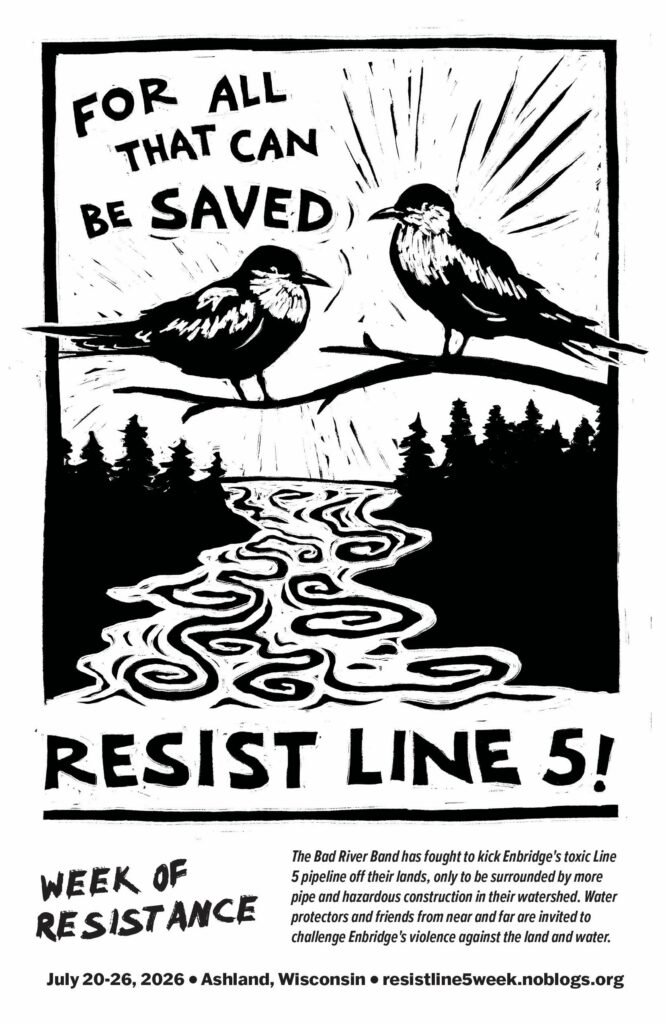
Join the Week of Resistance! From July 20–26 in Ashland, Wisconsin, water protectors near and far will come together to resist Line 5. Learn more, find your own camping, and RSVP for meals via resistline5week.noblogs.org. [It is recommended to open noblogs websites in a more secure browser, such as Tor.]
A Brief History of Colonization and Resistance in This Little Corner of Turtle Island
Turtle Island is being occupied by the American Empire. Indigenous peoples all over the continent have struggled and continue to struggle against genocide, displacement, and resource extraction. Meanwhile, folks in Northern Wisconsin across the political spectrum have historically been fiercely protective of Lake Superior.
In the time before 1800 the Anishinaabeg migrated west to the Great Lakes region following a prophecy about a place where food grows on the water, in response to mounting colonial threats to their people. That food—manoomin, or wild rice—is abundant in the sloughs around Bad River, where some Anishinaabeg ended their migration. To learn more about this deeply interesting chapter of history, see here. In Wisconsin and elsewhere, Ojibwe peoples have resisted displacement since the threat of colonial violence arrived.
In 1830 the Indian Removal Act was signed into law, giving settlers and the state license for ethnic cleansing, genocide, and settler colonialism. You might remember the Trail of Tears from history class. The Indian Removal Act is the law that started that horror, and it attacked communities across Turtle Island.
In 1854, pushing back against those policies of dispossession, Chief Buffalo and other tribal chiefs went to Washington D.C. to negotiate with president Millard Fillmore for the cancellation of the Indian removal order he was administering. Fillmore agreed that in exchange for another 13 million acres of land, the Lake Superior Ojibwe could retain their homeland with extended off-reservation hunting and fishing rights. This agreement became the Treaty of 1854.
The rights guaranteed by the 1854 treaty for the Ojibwe people to be able to continue to use the land and water are referred to legally as usufructory rights. They’re a cornerstone of Bad River’s legal arguments, and essential to the current livelihoods and strength of the Anishinaabe communities across the region.
In 1887, the federal government’s Bureau of Indian Affairs (BIA) broke up Bad River and other Native lands into small private lots called allotments—a policy extended in reach by the Dawes Act (1887), which was explicitly intended to force Native Americans to “assume a capitalist and proprietary relationship with property.”
“They had been ‘allotting’ the land [that makes up reservations], chopping them up into pieces. The rest of the land that is not distributed is now up for sale. Those parcels were bought by lumber companies. They should never have been sold. They should have stayed in our hands. All of the extra land that is not allotted out would now be free from white settlement.” —KEVIN BRUYNEEL in the film Bad River
Assimilation, a policy overseen by the BIA, was an effort to forcibly integrate native peoples into American culture. This was done to pull people away from the land, destroy traditional ecological knowledge, and support white settlement of indigenous lands. This isn’t conjecture—it’s the explicitly stated purpose of the policy, epitomized by the phrase “kill the Indian, save the man.” To be really clear: we understand these efforts by the U.S. Government to be the elements of a genocide. We bring this history up now because that campaign of genocide has never stopped: it continues through the work of companies like Enbridge.
In 1953, the Canadian company that would become Enbridge constructed Line 5 to move oil from western to eastern Canada. Pipelines haven’t always been vining across the continent: they’re the oil industry’s workaround to the power of striking dockworkers on the coasts. The cheapest and easiest pipeline route for the company was to dip down to the United States through the Great Lakes before heading back to Canada. Line 5 was installed on the Bad River Reservation, courtesy of the Bureau of Indian Affairs, without the consent of the Bad River Band.
The Bayfield Peninsula/Chequamegon Bay area has been settled by waves of colonizers. The people who came here historically made their livings in the logging, mining, and fishing industries. Although the vast majority of our original forests are gone and the lake is impacted by all kinds of threats, rural people generally have some level of love and respect for the land. People of many backgrounds live here now: farmers, loggers, fisherfolk, ecologists, back-to-the-landers, hippies, evangelical christians, hunters, retired academics, etc; and they have all proven able to protect the land and the waters when it counts.
Residents of many stripes are committed to the wellbeing of the Lake and the land. In facing outside threats, Native and settler communities have often fought together. The people of Bad River, in particular, have been fighting to protect their home. Joe Rose, a beloved Bad River elder who is now an ancestor, used to say that in terms of environmental campaigns and protecting the land, Bad River is batting 1000 and hasn’t lost yet (in baseball terms that means they’re crushing it). Bad River tribal members have been protecting their treaty rights since the treaties were signed, and their lands long before that.
The 1960-70’s bring the height of the Walleye Wars (a racist conflict that flares up every spearing season to this day) as well as landmark treaty rights cases: the Gurnoe and Voigt decisions. They’re hard-fought watershed affirmations of treaty rights, read more about them in Walleye Warriors by Rick Whaley and Walt Bresette.
More notable fights and wins in recent history include:
The fight against the Crandon Mine, which lasted from the 70’s to 2002 down in Mole Lake. The U.S. Supreme Court affirmed their right as a sovereign nation to enforce their own clean air and water standards. This made the mine economically unviable (industry relies on sacrifice zones!) and the company sold the land to the tribe, shuttering the project for good.
A 28 day train blockade and ceremony in 1996, that stopped the transport of hazardous sulfuric acid through Bad River. We celebrate the bravery of this moment in Bad River’s recent history: learn more here.
The fight against the Penokee Mine, which was proposed in 2010 and was fought for the next 5 years. Gogebic Taconite LLC (a Florida-based mining company, known locally as G-TAC) proposed an iron taconite mine in the Penokee hills of Northern Wisconsin, upstream of Bad River. Due to a mix of Tribal pressure and escalation combined with changing economics, the mining project was abandoned.
The community-wide rejection of a concentrated animal farm operation (CAFO) in 2014. Bayfield County, Red Cliff, and Bad River all rallied against the pig farm, preventing it from being built.
Lake Superior Not For Sale, a campaign to resist a south shore landowner’s bid to start a water bottling company in 2020. The campaign ended in a state-level lawsuit that affirmed the local municipalities’ right to say no to the project on environmental grounds.
“Often, when Native Nations assert their treaty rights and sovereignty, they are confronted with a backlash from their [settler] neighbors, who are fearful of losing control of the natural resources. Yet, when both groups are faced with an outside threat to their common environment…these communities have unexpectedly joined together to protect the resources.” —Zoltan Grossman in Unlikely Alliances
The construction that is currently underway is as much a part of the same pattern of abuse against the people and the land as the rest of the history of colonization. There is a long history of missing and murdered Indigenous women in areas around man-camps. Even if Enbridge’s reroute never spilled a single drop of oil (which is unlikely given their track record), Enbridge is already actively threatening the very safety of Indigenous communities in this region. No matter how well-rehearsed their corporate talking points are, Enbridge is nothing more than the latest iteration of Western imperialism on Turtle Island.
This series follows Enbridge’s ongoing construction of the Line 5 oil pipeline in Wisconsin. Right now, Enbridge is building their “re-route” section of the pipeline around Mashkiiziibii (the Bad River Reservation), posing a continual threat to Indigenous sovereignty, Lake Superior, the Bad River Watershed, and the land.
Join the Week of Resistance! From July 20–26 in Ashland, Wisconsin, water protectors near and far will come together to resist Line 5. Learn more, find your own camping, and RSVP for meals via resistline5week.noblogs.org. [It is recommended to access noblogs websites using more secure browsers, such as Tor].
What is Line 5?
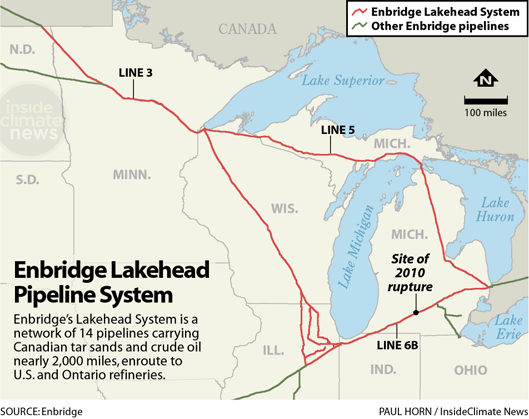
Line 5 is an oil pipeline built in 1953 through Wisconsin and Michigan without the consent of local Tribal Nations. Line 5 is part of the Lakehead Pipeline System, a network of pipelines that carry oil from the Canadian Alberta tar sands. Since being built, Line 5 has spilled a total of 1.1 million gallons of oil, violating Indigenous treaty rights and causing immense damage to local watersheds and ecosystems.
The existing Line 5 is owned by Enbridge, the multi-national corporation responsible for the Line 3 pipeline in Minnesota, which faces over a decade of resistance from thousands of community members. Instead of cleaning up their old, leaking pipelines, Enbridge is now building new sections of pipe along the Line 5 route: a new section under the Straits of Mackinac lake bed, and the Wisconsin re-route around Mashkiiziibii (the Bad River Reservation).
What is the Line 5 Re-Route around Mashkiiziibii?
In 2023, the Bad River Band of Lake Superior Chippewa won a lawsuit against Enbridge. The courts ruled that Enbridge is trespassing on their land by operating the old Line 5 through the heart of the Reservation, and ordered the company to pay $5.1 million in damages. This legal victory is part of the long legacy of Indigenous-led resistance to colonialism and extraction in the Great Lakes region and beyond.
Sadly, Enbridge is continuing to operate and build new sections of Line 5. Instead of cleaning up the old line, Enbridge is building a brand new “re-route” section around the perimeter of the Bad River Reservation. This “re-route” is just another direct attack on Indigenous sovereignty, threatening further harm to the Bad River Watershed, Lake Superior, and the land.
Line 5 threatens Indigenous communities and sovereignty, the land, the water, the climate, non-human relatives, and the very future of the planet.
Line 5 exists in violation of multiple treaties with Tribal Nations, such as the Treaty of 1854. Pipeline construction also brings with it an influx of workers who are typically out-of-town men, housed in “man camps” that directly contribute tothe Missing and Murdered Indigenous Women and Relatives crisis (MMIWR). The fossil fuel industry is inherently tied to colonialism and violence against Indigenous communities, and must be stopped.
Not only is it incredibly destructive to build an oil pipeline — involving clear-cuts, dragging heavy equipment through wetlands and drilling underneath waterways using a slurry of mud and toxic chemicals — the pipeline then causes ongoing disasters through oil leaks.
It is not a question of if the pipeline will spill, but when. And Enbridge has a miserable track record. They’re responsible for over 800 spills in the last 15 years, including several of the largest oil spills in recent history: in Kalamazoo, MI (>1,000,000 gallons in 2010), Grand Rapids, MN (1,700,000 gallons in 1991), and Jefferson County, WI (~69,000 gallons in 2024). Their natural gas pipelines have also caused devastating explosions in Ohio, Texas, and British Columbia.
The oil in the pipe is extracted in the Alberta tar sandsin mining operations that stretch across an area bigger than all of England. The mining has cleared nearly 2 million acres of boreal forest, created massive tailings ponds filled with toxic waste, and caused local health crises, particularly for Indigenous communities.
In the face of climate catastrophe,which threatens the very future of our species and our non-human relatives, more fossil fuel infrastructure is the last thing we need. Enbridge should be removing their old, leaking pipes, not building new infrastructure that fans the flames of collapse.
Enbridge Lies
Enbridge has a long history of pouring money into public relations campaigns to try and trick us into believing their pipelines are safe and necessary, despite all the evidence saying otherwise. With Line 5, they have continued this tactic through intensive regional advertising, in an effort to drown out voices of resistance. They’ve mailed open letters to thousands of households in Bayfield and Ashland counties, they sponsor local radio stations, sports teams, and events, they donate to local law enforcement offices, and they have full page ads in every edition of the Ashland Daily Press.
But we don’t have to listen to Enbridge’s lies, including the myth that Line 5’s existence is good for the economy. Contrary to Enbridge’s claims, we know that Line 5’s existencedoesn’t actually lower local gasoline prices. The Bad River v. Enbridge case showed that gas prices in Wisconsin and Michigan would only go up by half a cent per gallon if the pipe was shut off.
What’s happening now?
Enbridge is building the Line 5 Re-Route right now. They could complete construction on Line 5 by the end of the summer, although it may take months longer.
Already, Enbridge has clear-cut forests and started Horizontal Directional Drilling (HDD) underneath waterways, including Silver Creek, to build the Line 5 re-route. They have been using Ashland’s municipal water, contaminating it with an ‘industry secret’ mix of toxic chemicals that enable them to drill.
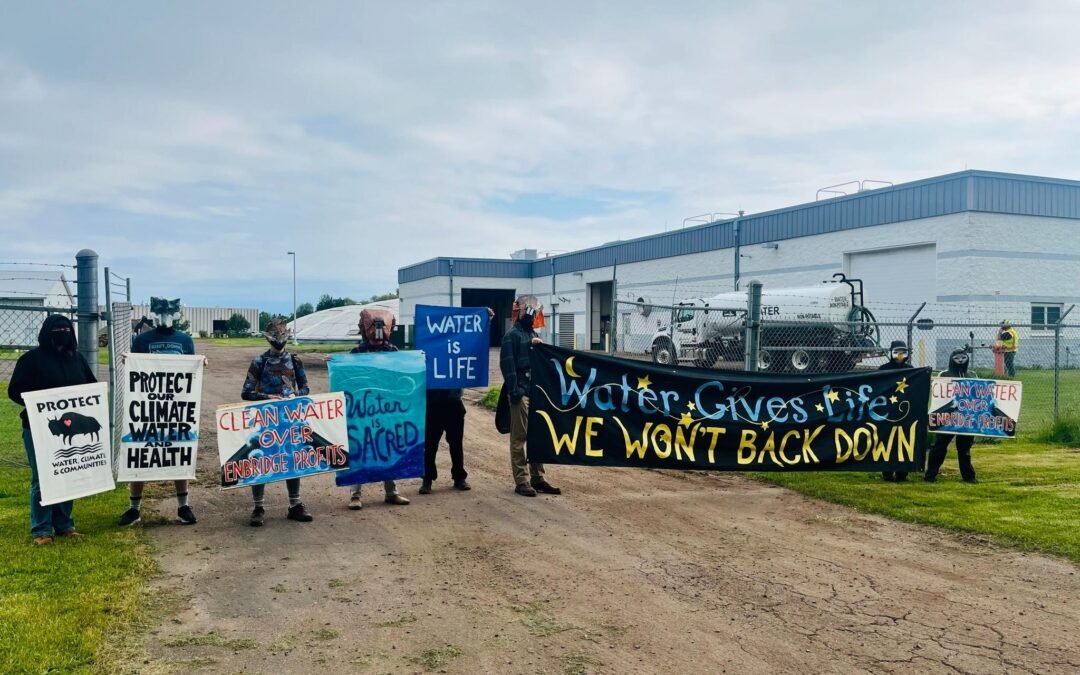
On June 24, 2026, community members gathered at the Ashland water station to protest Ashland’s cooperation with Enbridge. In a statement, they wrote: “The city of Ashland is helping this multibillion dollar fossil fuel corporation desecrate our water and assisting Enbridge in their continued poisoning of our home… We’re choosing life, not death.”
What can we do to stop Line 5?
It is urgent that we come together, drawing on a variety of tactics and strategies, to stop construction and defend the land.
Join the Week of Resistance! From July 20–26 in Ashland, Wisconsin, water protectors near and far will come together to resist Line 5. Join us in monitoring construction, making art, sharing stories, learning from each other, and rallying to bring awareness to the Missing and Murdered Indigenous Women & Relatives crisis. Learn more, find your own camping, and RSVP for meals via resistline5week.noblogs.org. [It is recommended to access noblogs websites using more secure browsers, such as Tor]
Drilling fluid spilled into a forested wetland in Iron County on Saturday, June 27, 2026. Photo courtesy of Earthjustice via the Bad River tribe (via WPR).
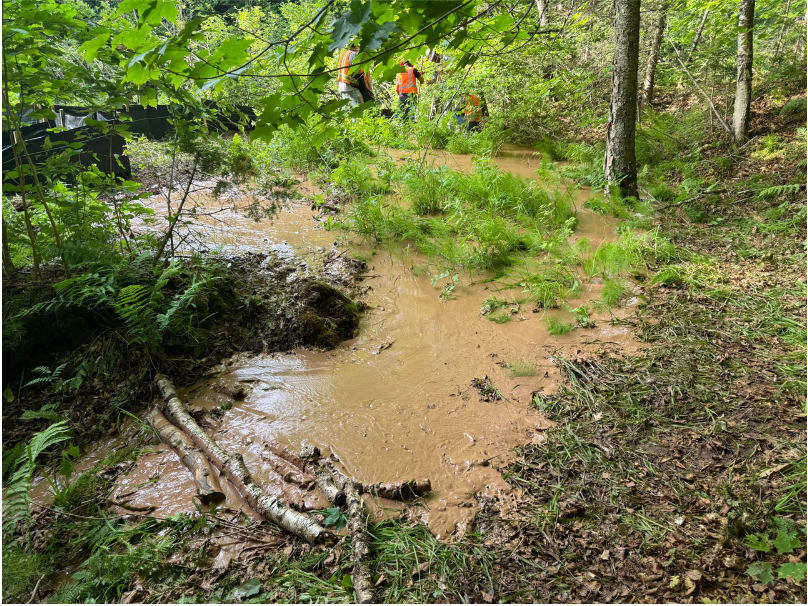
IRON COUNTY, WI — On June 23rd, Bad River elder Joe Bates witnessed a pool of brown slurry around one of Enbridge’s Horizontal Directional Drilling (HDD) site on the Vaughn Creek through his drone. Bates and other community members have been monitoring Enbridge’s Line 5 reroute construction for several months, as Enbridge has a history of releasing hazardous fluids into the watershed during its construction projects.
Enbridge claims that a drilling fluid spill had occurred four days later at 4:30 pm. It is estimated by the DNR that up to 1,900 gallons of drilling fluid and bentonite clay flooded the impacted wetland. Another 8 gallons of clay spilled into Vaughn Creek. Despite this direct violation of the waterway and wetland permit issued by the DNR, no stay on construction has been issued as of June 30th. This is the fourth notice of noncompliance the DNR has issued Enbridge since construction started in March.
The exact composition of the drilling fluid used by Enbridge is unknown. Although the DNR has a list of approved materials for HDD, several of these materials contain “proprietary ingredients” which are not disclosed to the public.
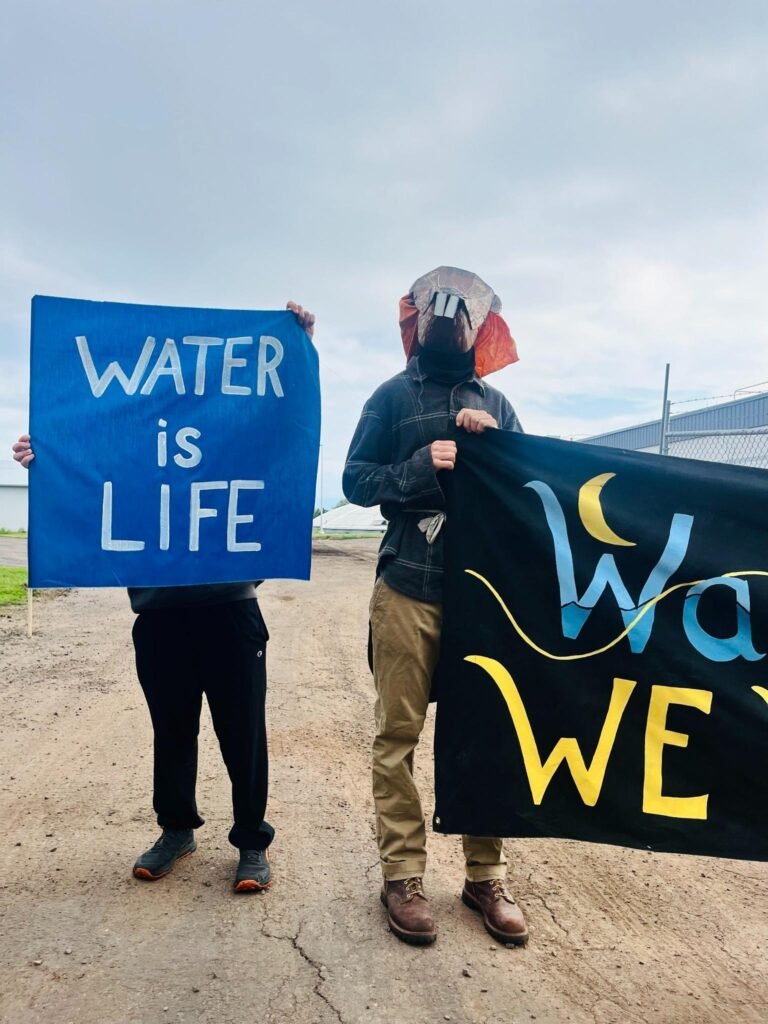
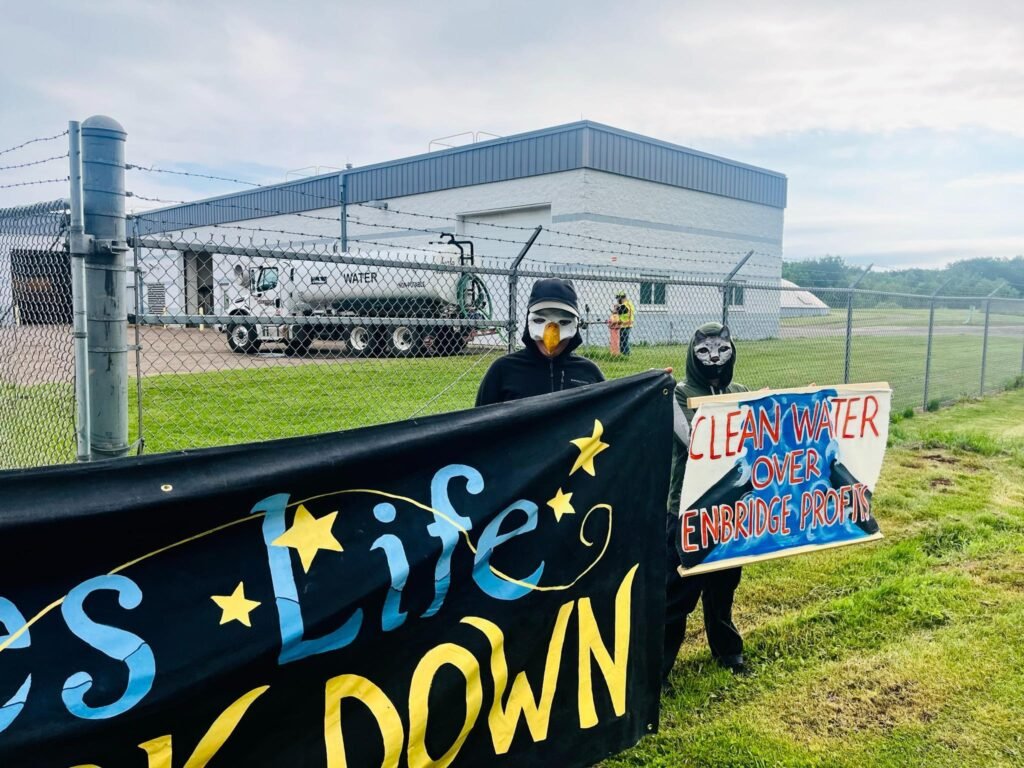
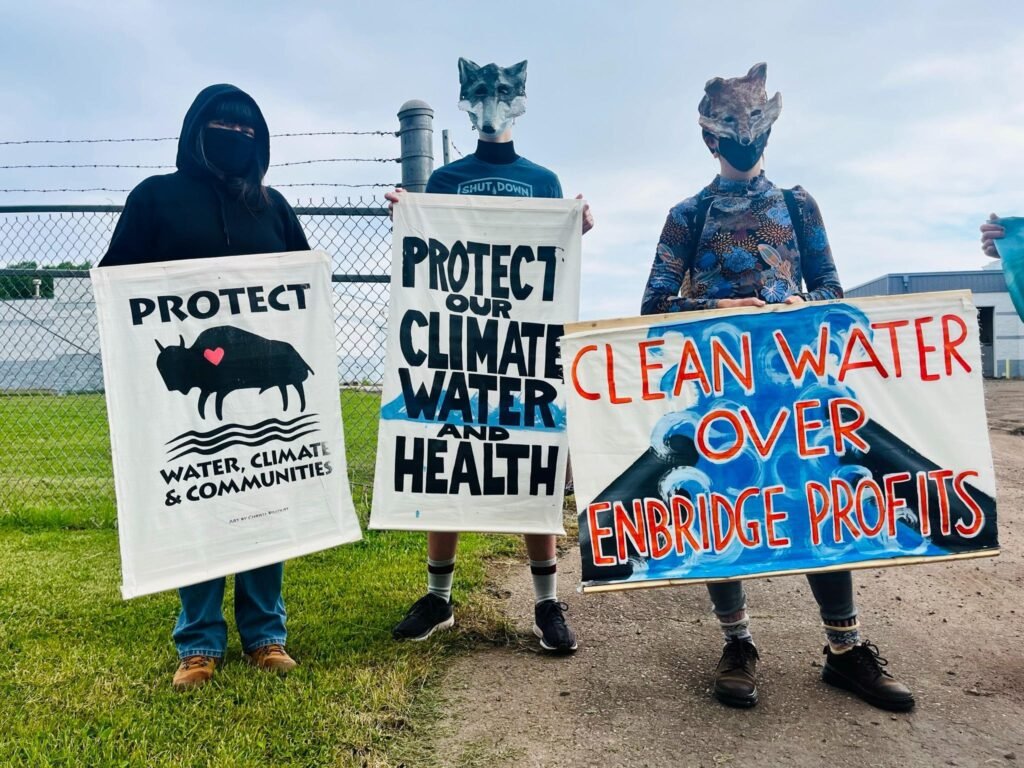
ASHLAND, WI — On Wednesday morning, June 24th, community members protested against the City of Ashland for allowing Michels’ Construction (an Enbridge subcontractor) to use municipal water in Line 5 construction. Gathered outside the municipal water station, community members wore animal puppet masks and held banners reading: “Clean Water over Enbridge Profits,” “Water is Sacred,” and “Water Gives Life, We Won’t Back Down.”
Locals have observed Michels’ water trucks filling their tanks at the municipal water station before heading to construction sites along the Line 5 route. The company is currently building a new section of Line 5 that reroutes around the Bad River Reservation, using Horizontal Directional Drilling (HDD) to bore under sensitive waterways including Silver Creek and Vaughn Creek. As part of the drilling process, Enbridge adds an undisclosed mixture of chemicals to the water they use (according to the Environmental Impact Statement), which then contaminate local waterways.
Where does the City of Ashland stand?
The Great Lakes Compact, a law that applies to the City of Ashland, states that any water taken out of a Great Lake must be returned in the same condition. The City of Ashland has not informed the public of any contract allowing Michaels to extract municipal water, so it is a mystery how much municipal water Michaels is extracting, or how the city plans to clean the water once it returns, in an unknown state, to the Ashland treatment plant and subsequently to Lake Superior.
In a statement released this morning, community members protesting shared that “Michels, a subcontractor of Enbridge, is taking precious water from Lake Superior out of the City of Ashland municipal water supply to build Line 5. This sacred water is being used to devastate our wetland and forest ecosystems and being returned with unknown contaminants for our community to deal with. This is a violation of the Great Lakes Compact and a direct threat to Anishinaabe Treaty Rights. Ashland needs to stand by their resolution of support to the Bad River Tribe and demand a halt to Michels’ water usage.”
Why does it matter that the water is used in drilling?
HDD machines use special drilling fluid in their operation called “drilling mud.” Though the exact composition of this material is unknown, Enbridge claims the fluid is comprised mostly of bentonite clay, with additives which, according to the Environmental Impact Statement, “are listed on the DNR’s Approved Horizontal Directional Drilling Products List.” This list includes four materials which contain “proprietary ingredients,” meaning the public is not privy to the ingredients of all possible additives in the fluid. Drilling fluid is known to escape the bore hole during the drilling process, in events called “frac-outs.”
Frac-outs are not simply a potential risk of HDD projects. They are a near-certain result. During the construction of Enbridge’s Line 3 in Minnesota, there were at least 28 releases of drilling fluid in or near waterways, wetlands, and other sensetive areas. It is estimated that thousands of gallons of drilling fluid were released into the surface waters along Line 3. This water usage also impacts the Treaty Rights of the Anishinaabe tribes with hunting and gathering rights protected under the1842 Treaty of La Pointe.
Full Statement from the community members:
“Boozhoo Indinawemaganodog (Hello all of my relatives)
Michels Construction, a subcontractor of Enbridge, is taking precious water from Lake Superior out of the City of Ashland municipal water supply to build Line 5. This sacred water is being used to devastate our wetland and forest ecosystems and being returned with unknown contaminants for our community to deal with. This is a violation of the Great Lakes Compact and a direct threat to Anishinaabe Treaty Rights. Ashland needs to stand by their resolution of support to the Bad River Tribe and demand a halt to Michels’ water usage.
We’re a group of local folks here today to give voice to the Indigenous wisdom we’ve heard and integrated into our hearts and visions for living a good life (Mino bimaadiziwin). We begin this message with the Anishinaabe greeting because it is an acknowledgement of all of our relatives and our interconnection. We are wolves, foxes, beavers, eagles, owls, bears, wild rice, fish and all of the waters… we acknowledge and speak for the creatures of our home and for the generations to come. They suffer from the disruption of our soils and waters, from what Enbridge is doing with our local municipal water, and from the continuation of their extractive infrastructure. It is way past time to compost these systems for healthier, more harmonious ways. We call on everybody to cultivate courage and vision, to take action for the integrity and health of our bodies, our water, and our ecosystems- simultaneously taking steps away from the temptation to go along with the industrial corporate hegemony that is connected to powerlessness, addiction and consumption. Another world is possible, let’s make it happen. Miigwech.”