
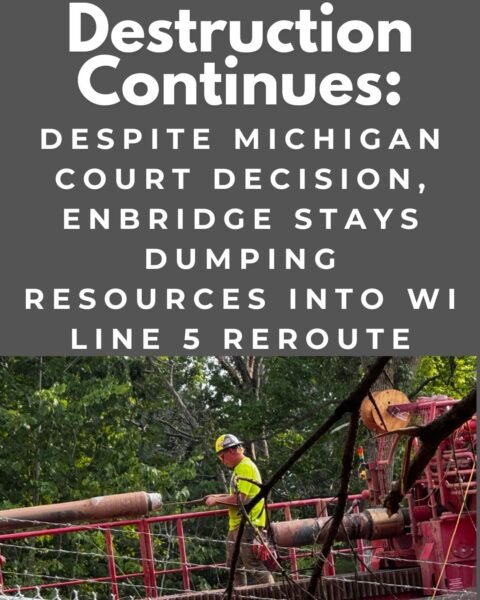
At the end of July, Michigan and federal courts delivered blows to Enbridge’s Line 5 oil pipeline. The movement to Shut Down Line 5 is now more possible than ever, due to the persistent efforts of local Tribes and allies in the Great Lakes region. Yet despite the uncertainty of the pipeline’s future, Enbridge continues to barrel forward with construction on the Bad River Reroute in Wisconsin – in large part because the courts fell short.
State and Federal Courts Rule Against Line 5, But Fail to Shut It Down
Background: The corporation has been trying to replace two sections of Line 5: the Bad River Reroute in Wisconsin, and the section beneath the Straits of Mackinac (where the company is seeking permitting to bore a new four-mile tunnel beneath the bedrock).
Bad River Reroute Update: On July 30, the federal Seventh Circuit Court of Appeals ruled that Enbridge has been trespassing on the Bad River Band of Lake Superior Chippewa’s reservation by operating a stretch of Line 5 pipeline through their land despite easements expiring in 2013. This affirmed a 2023 federal judge decision siding with the Tribe in their lawsuit against Enbridge. However, the court decision falls short in two major ways:
1) The federal court has failed to establish a timeline for Enbridge to remove the section of Line 5 through the Bad River Reservation. The court had the power to set this timeline, but instead kicked that decision to a District Court. The federal judge had ruled that Enbridge remove the section by June 16, 2026, so the company was already past the original legal deadline. Now it could take months to years for the lower court to set and uphold a new timeline. Until then, Enbridge has an ungrounded carte blanche to continue the flow of oil on Tribal lands.
2) The court ruling, same as the federal judge ruling, still allows Enbridge to build its Bad River Reroute around the reservation. The Reroute is just another direct attack on Indigenous sovereignty, threatening further harm to the Bad River Watershed, Lake Superior, and the land. The Bad River Band has demanded that Enbridge to leave their watershed, but the company refused.
Straits of Mackinac Update: On July 31, the Michigan Supreme Court overturned a key permit that Enbridge needs to bury a replacement section of Line 5 underneath the Straits of Mackinac. Next, the permit will go back to the Michigan Public Service Commission, who will have to re-analyze the projects’ environmental impacts as well as how it would affect public use rights in the Great Lakes. This is a legal victory that the Bay Mills Indian Community, other Tribal Nations and allies fought hard for.
Still, Enbridge remains allowed to operate Line 5 through Michigan. And it remains to be seen if the Michigan Public Service Commission will re-issue the permit.
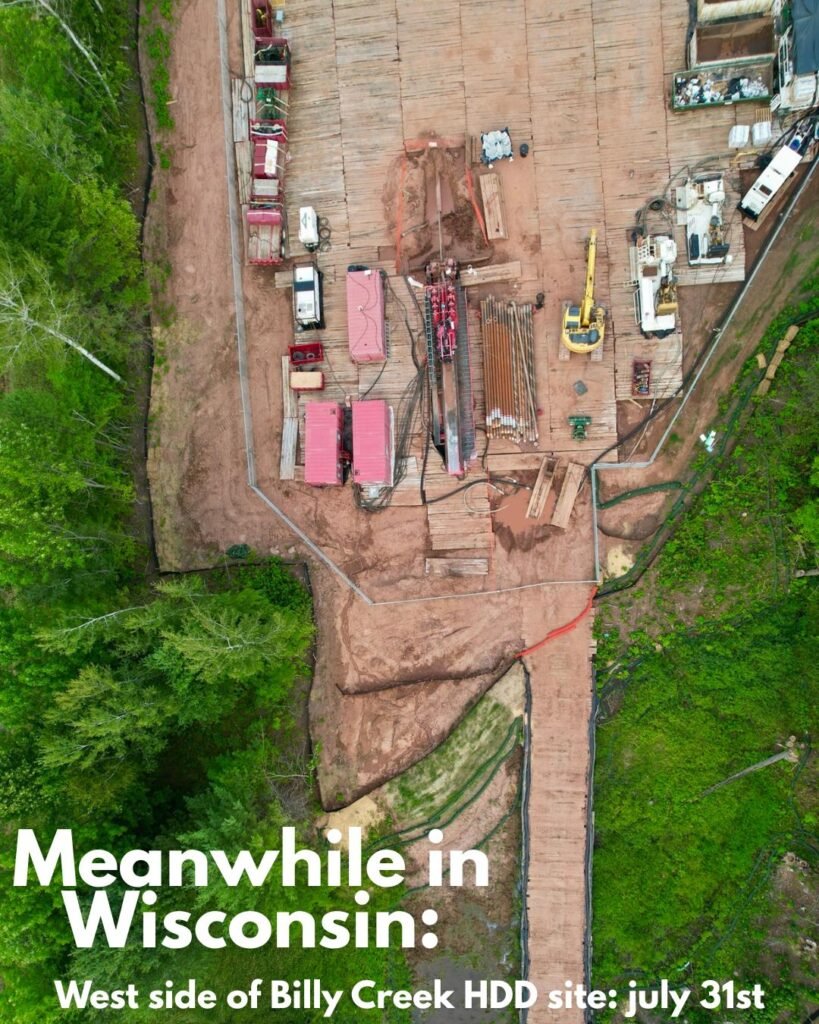
Construction Continues on the Bad River Reroute
For communities affected by the Bad River Reroute, the federal court victory tastes bitter. Because of the courts’ failures, Enbridge continues rushing forward with Reroute construction.
The Bad River Tribe continues to stand up for their treaty rights and for the health of the water, the land, and future generations. On July 22, the Tribe and environmental groups filed a lawsuit challenging the legality of Enbridge building its Reroute across four waterways.
Since Reroute construction began last February, the Wisconsin DNR has issued Enbridge four notices of noncompliance. Most recently, on June 23rd, Enbridge spilled roughly 1,900 gallons of drilling fluid and bentonite clay into the wetland. The Reroute crosses nearly 200 waterbodies and impacts more than 100 acres of wetlands, impacting ecosystems and drinking water for the Bad River Tribe and other local communities.
Enbridge has a long history of releasing hazardous fluids into the watershed during its construction projects. Enbridge’s construction on Line 3 in northern Minnesota led to 28 frac-outs at 19 water crossings, which the company has yet to meaningfully remediate. With this track record, it is highly likely that Enbridge will continue to cause irreparable harm to local waterways for as long as Line 5 remains.
For more updates on the Bad River Reroute, see the Communities United by Water blog.