March 1-May 1
Seasonal roadway weight restrictions go into effect in Wisconsin. Enbridge will work on logging the 497 acres that need to be deforested using chain saws and do any other work they can without bringing heavy machinery onto the state highways. see https://watchline5.com/ashland-county-road-weight-limits/
March 1-June 15
Various restrictions on in-stream construction activities for specific waterways due to fish spawning. see https://watchline5.com/timing-restrictions-fish/
Early April:
Enbridge will sign contracts with heavy machinery companies to lease heavy equipment for May
Mid April-Mid August:
Bird and bat breeding season prompts various state-wide restrictions on tree cutting.
May 1:
Seasonal roadway restrictions will lift and Enbridge will start grading, blasting and trenching.
September 15-May 15
Various restrictions on in-stream construction activities for specific waterways due to fish spawning. see https://watchline5.com/timing-restrictions-fish/
***Note: The information in the timeline was presented by DNR and Enbridge attorneys in a recent court hearing. Please take it with a grain of salt as these entities do not always follow the plans they present in court!
Pre-construction activities
– Surveying, installing signage
– reinforcing roadways and culverts near the right of way
– work on access roads: adding gravel to existing farm roads and/or driveways or building new access roads; grading, adding matting so access roads can hold heavy equipment.
– Staging matting yards and pipe yards; building man camp(s) etc
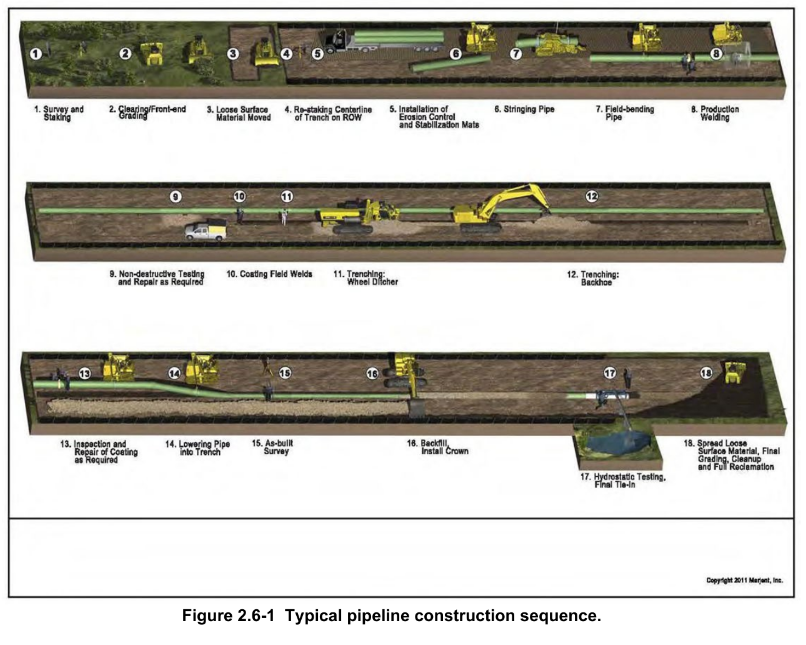
Typical sequence of pipeline construction: (see diagram on p 78 of the EIS)
https://watchline5.com/wp-content/uploads/2026/01/EL5_FinalEIS-enbridge-line-5_compressed.pdf:
a. Survey and Staking
b. Clearing/front-end grading (includes clear-cutting).
c. Move loose surface material (probably with a bulldozer)
d. Re-staking the centerline of the trench on the Right of Way
e. Installing erosion control and stabilization mats
f. Stringing pipe (placing the pipe next to the RoW, using side boom tractors, mobile cranes, or vacuum lifting equipment)
g. Field-bending pipe segments (done by a track-mounted, hydraulic pipe-bending machine)
h. Production welding (welding the pipe segments together on the side of the trench)
i. Non-destructive testing of pipe and repair, as required (usually 10% of welds are tested in the field, using x-rays or ultrasounds).
j. Coating field welds on the pipe (the welds connecting pipe segments are coated on the outside of the pipe with an anti-corrosion coating)
k. Trenching, using a wheel ditcher
l. Trenching, using a backhoe
m. Inspection and repair of pipe coating as required
n. Inspection of the trench, potential dewatering
o. Lowering pipe into the trench (using side-boom tractors)
p. Conducting the as-built survey
q. Back-filling material into the trench (using angle blade dozers, draglines, or backhoes)
r. Hydrostatic testing (cleaning the inside of the pipe, then filling the new pipe segments with water, raising the internal pressure level, and holding that pressure to test for leaks)
s. Final tie-in (attaching the reroute pipe segments to the rest of Line 5)
t. Spread loose surface material, final grading, cleanup and site remediation
Diagram below: Typical pipeline construction sequence; from p. 78 of the EIS (DNR, Enbridge; and Marjent, Inc.)